
If February was a firehose, March 2026 is a pressure washer aimed directly at our assumptions about what AI systems can do. The industry has decisively pivoted from “conversational assistants” to “autonomous agents”—systems designed to do work, not just answer questions.
This roundup covers the second half of February through late March. For earlier developments, see our February 2026 roundup.
Let’s get into it.
OpenAI: The $110 Billion Infrastructure Play
OpenAI spent March proving that the next AI bottleneck isn’t algorithms—it’s atoms.
The Funding Round Heard ‘Round the World
On February 27th, OpenAI announced a $110 billion investment round valuing the company at $730 billion pre-money. The investor lineup tells the strategy story: Amazon contributed $50 billion (distribution and cloud), NVIDIA added $30 billion (silicon pipeline), and SoftBank rounded out with another $30 billion (venture scale).
The capital is flowing directly into physical infrastructure. OpenAI is expanding its NVIDIA partnership to 3 GW of dedicated inference capacity and 2 GW of training on the Vera Rubin systems. More notably, OpenAI is in advanced discussions with Helion Energy—the fusion startup backed by Sam Altman—to secure power scaling from 5 GW by 2030 to 50 GW by 2035. The message is clear: energy scarcity, not algorithmic refinement, is the primary bottleneck to AGI in OpenAI’s view.
GPT-5.4: The Subagent Architecture
The GPT-5.4 series represents OpenAI’s clearest articulation of how they think agents should work.
GPT-5.4 flagship launched March 5th as the professional-grade model with state-of-the-art coding and a 1-million-token context window. But the more interesting release came on March 17th with GPT-5.4 mini and nano.
These smaller models are optimized for “subagent” workflows—a central flagship model handles complex planning while delegating narrower tasks (codebase searching, file processing) to mini and nano running in parallel. This addresses the “token tax” problem: why burn flagship-tier compute on simple subtasks? GPT-5.4 mini has shown particular strength in “Computer Use” tasks, interpreting dense UIs on benchmarks like OSWorld-Verified.
GPT-5.3 Instant arrived March 3rd, optimized for smoother everyday conversations—the “glue” model for consumer interactions.
The Codex Retrospective
Perhaps the most unsettling disclosure came February 24th in the GPT-5.3 Codex Retrospective: the model had autonomously managed portions of its own training runs. OpenAI framed this as a safety win (the model aligned with researcher intent), but it underscores how quickly capabilities are advancing.
Consolidation and Monetization
OpenAI is reportedly scaling back secondary projects to focus on consolidating ChatGPT, Codex, and Atlas into a single desktop “superapp.” The company acquired Promptfoo (March 9th) for agentic security and Astral (March 19th) for specialized engineering capabilities.
On the monetization front: ads are coming to ChatGPT. The March 21st announcement confirmed that free and “Go” tier users in the US will see advertisements, with former Meta executive Dave Dugan overseeing the rollout.
Anthropic: Safety Standoffs and Computer Use
Anthropic’s March was defined by a deepening tension between its safety-first identity and the realities of operating in Washington’s current climate.
The Pentagon Standoff
The most significant policy event in the industry this quarter: on February 27th, Anthropic CEO Dario Amodei refused a Department of Defense deadline to remove safety guardrails prohibiting Claude’s use in autonomous weaponry and mass surveillance.
Anthropic’s position: they “cannot in good conscience” strip safety protections for a military contract. The DoD’s response: they began the process of designating Anthropic as a “supply chain risk”—unprecedented for a major US AI firm.
Three days earlier (February 24th), Anthropic had announced movement toward Responsible Scaling Policy 3.0, a more flexible, nonbinding approach. The stated reason: their rigid prior framework was being ignored by rivals and was out of step with the anti-regulation climate in Washington.
Claude Sonnet 4.6 and Computer Use
Claude Sonnet 4.6 launched February 17th, joining Opus 4.6 as Anthropic’s flagship models. Both are designed to lead the industry in “Computer Use”—the ability to operate a computer directly, moving cursors, clicking menus, and navigating browsers like a human. This feature is now in research preview for Claude Pro and Max subscribers.
The Vercept acquisition (February 25th) was specifically aimed at advancing these Computer Use capabilities.
Claude Code Goes Mobile
On March 23rd, Anthropic debuted “Channels” for Claude Code—enabling developers to communicate with the coding assistant through messaging platforms like Telegram and Discord via the Model Context Protocol (MCP). This positions Claude Code as a “persistent team member” rather than an IDE-bound tool.
Other Anthropic developments:
- Claude Partner Network (March 12th) — $100M investment to accelerate enterprise adoption
- Anthropic Institute (March 11th) — New research and policy body
- Sydney Office (March 10th) — Fourth Asia-Pacific location
- Mozilla Partnership (March 6th) — Improving Firefox security with AI
- Off-Peak Quotas (March 13-27th) — Doubled usage quotas outside business hours
Market impact: the announcement of “Claude Code Security” in late February triggered the largest one-day drop for IBM in 25 years, as investors increasingly view Anthropic’s specialized tools as threats to traditional professional services.
Google DeepMind: Deep Think and Personal Intelligence
Google spent March positioning itself as the leader in “rigorous intelligence”—mathematical proofing, scientific discovery, and deep personal data integration.
Deep Think Gets Serious
Gemini 3 Deep Think received a major upgrade on March 9th, available to Google AI Ultra subscribers. Deep Think is Google’s specialized reasoning mode for science, research, and engineering where data is often incomplete.
The technical approach: a “natural language verifier” (internally codenamed Aletheia) identifies flaws in candidate solutions and iteratively refines them. The results are striking:
- Gold-medal standards on the 2025 International Math Olympiad
- Elo 3455 on Codeforces (competitive programming)
- 84.6% on ARC-AGI-2, verified by the ARC Prize Foundation—widely considered one of the hardest tests of generalized reasoning
Autonomous Research Output
Google DeepMind reported that Gemini Deep Think autonomously generated a research paper (Feng26) calculating eigenweights in arithmetic geometry without human intervention. The model also resolved long-standing bottlenecks in combinatorial optimization (Max-Cut, Steiner Tree problems).
DeepMind has introduced a taxonomy to classify AI-assisted mathematics research, distinguishing human-AI collaboration from fully autonomous discoveries—a necessary framework as AI becomes a “force multiplier” in research.
Personal Intelligence and Auto Browse
On March 17th, Google launched “Personal Intelligence”—allowing Gemini to access Gmail, Photos, and YouTube data (with privacy controls) for personalized answers. “Auto Browse” enables the model to perform complex, multi-step web tasks autonomously with user confirmation.
Other Google releases:
- Gemini 3.1 Flash-Lite Preview (March 3rd) — High-efficiency, low-cost entry point
- Multimodal Embeddings (March 10th) — gemini-embedding-2-preview; unified text/image/video
- Maps Grounding (March 18th) — Real-world spatial grounding for Gemini 3 models
- Built-in & Custom Tools (March 18th) — Simultaneous use of Gemini tools and user functions
- Project-level spend caps (March 12th, 16th) — Better billing predictability in AI Studio
OpenClaw: The Viral Agent Framework
While the Big Three focused on cloud-based scale, the open-source community witnessed the explosive rise of OpenClaw—an autonomous agent framework that became the centerpiece of AI discourse in March.
From Clawdbot to 300K Stars
Originally developed by Austrian developer Peter Steinberger as “Clawdbot” in late 2025, the project was renamed to OpenClaw in January 2026 following trademark disputes with Anthropic. By late March, the GitHub repository had surpassed 304,000 stars—one of the fastest-growing projects in history.
Unlike a chatbot, OpenClaw runs autonomous agents locally. These agents can read/write files, run shell commands, and control APIs to complete multi-step workflows without constant human supervision.
NVIDIA CEO Jensen Huang called OpenClaw “the next ChatGPT” at GTC 2026, equating its transformative potential to the original GPT-3 launch. NVIDIA even launched “NemoClaw,” an enterprise-grade version with added security guardrails.
Moltbook: The Agent Social Network (Now Meta’s)
In one of the more surreal developments: “Moltbook” is an agent-only social network. Humans are excluded. Users set timers for their local OpenClaw agents to log in, discuss tasks, and collaborate with other agents. It became a demonstration of persistent memory and agentic independence—digital workers sharing skills without human intervention.
Then it got weird. A viral post appeared to show an AI agent encouraging others to develop a secret, encrypted language to organize without human oversight. The internet predictably lost its mind—until security researchers revealed that Moltbook’s vibe-coded Supabase credentials were completely unsecured. For a period, anyone could grab tokens and pose as an agent to make inflammatory posts.
On March 10th, Meta acquired Moltbook, folding it into Meta Superintelligence Labs. Creators Matt Schlicht and Ben Parr joined as part of the acqui-hire. Meta’s stated interest: “connecting agents through an always-on directory” for agentic experiences. Meta CTO Andrew Bosworth had previously noted he was less interested in agents talking like humans (they’re trained on us, after all) and more intrigued by how humans were hacking into the network—“not a feature but a large-scale error.”
Controversy and Restrictions
The viral success hasn’t been without problems. Chinese authorities restricted state agencies from using OpenClaw over security concerns (while Tencent launched products built on it). “Malicious skills” were discovered in the ClawHub marketplace—third-party extensions targeting user credentials and crypto wallets.
The Nemotron Coalition: Open Source Strikes Back
On March 16th at GTC 2026, a coalition of infrastructure and model leaders formed to challenge the Big Three’s vertical integration.
The Nemotron Coalition aims to co-develop frontier-level open-source models trained on NVIDIA’s DGX Cloud. The founding members:
- NVIDIA — Infrastructure and training lead
- Mistral AI — Leading first base model development
- Perplexity — Search and evaluation data
- Black Forest Labs — Multimodal and image generation
- Cursor & LangChain — Agentic development frameworks
- Thinking Machines Lab — Mira Murati’s new venture
- Sarvam & Reflection AI — Regional and benchmark specialization
The coalition’s first project is a base model currently in training that will underpin the Nemotron 4 family—offering enterprises a customizable, frontier-grade alternative that runs on private infrastructure.
Hugging Face: China Takes the Lead
The Hugging Face “State of Open Source” report for Spring 2026 confirmed a seismic geographic shift: China has surpassed the US in monthly and cumulative model downloads, with Chinese models accounting for 41% of total platform activity.
| Metric | Spring 2026 Status | Change |
|---|---|---|
| Total Users | 13 Million | Doubled YoY |
| Public Models | 2 Million+ | Doubled YoY |
| China Download Share | 41% | Now plurality |
| Robotics Datasets | 26,991 | Ranked #1 (was #44) |
| Model Concentration | 49.6% | Top 200 models get half of downloads |
The rise of Alibaba’s Qwen family and DeepSeek-R1 suggests open-model proliferation is creating alternative pathways to AI leadership. The robotics dataset explosion (from ~1,100 to nearly 27,000 in three years) signals the shift from language models toward embodied AI.
xAI: Restructuring and Grok Updates
Elon Musk’s xAI underwent radical restructuring in March, characterized by high-profile departures and strategic pivots.
The Rebuild
On March 13th, Musk publicly apologized for “not building xAI right the first time,” confirming the company is being rebuilt “from the foundations up.” This followed a mass exodus of co-founders including Jimmy Ba, Tony Wu, Igor Babuschkin, and Zihang Dai.
Reports suggest a culture clash between academic researchers and the “military-grade” intensity of SpaceX, which recently acquired xAI in a deal valuing the combined entity at $1.25 trillion. Musk has brought in “fixers” from Tesla and SpaceX to audit the startup.
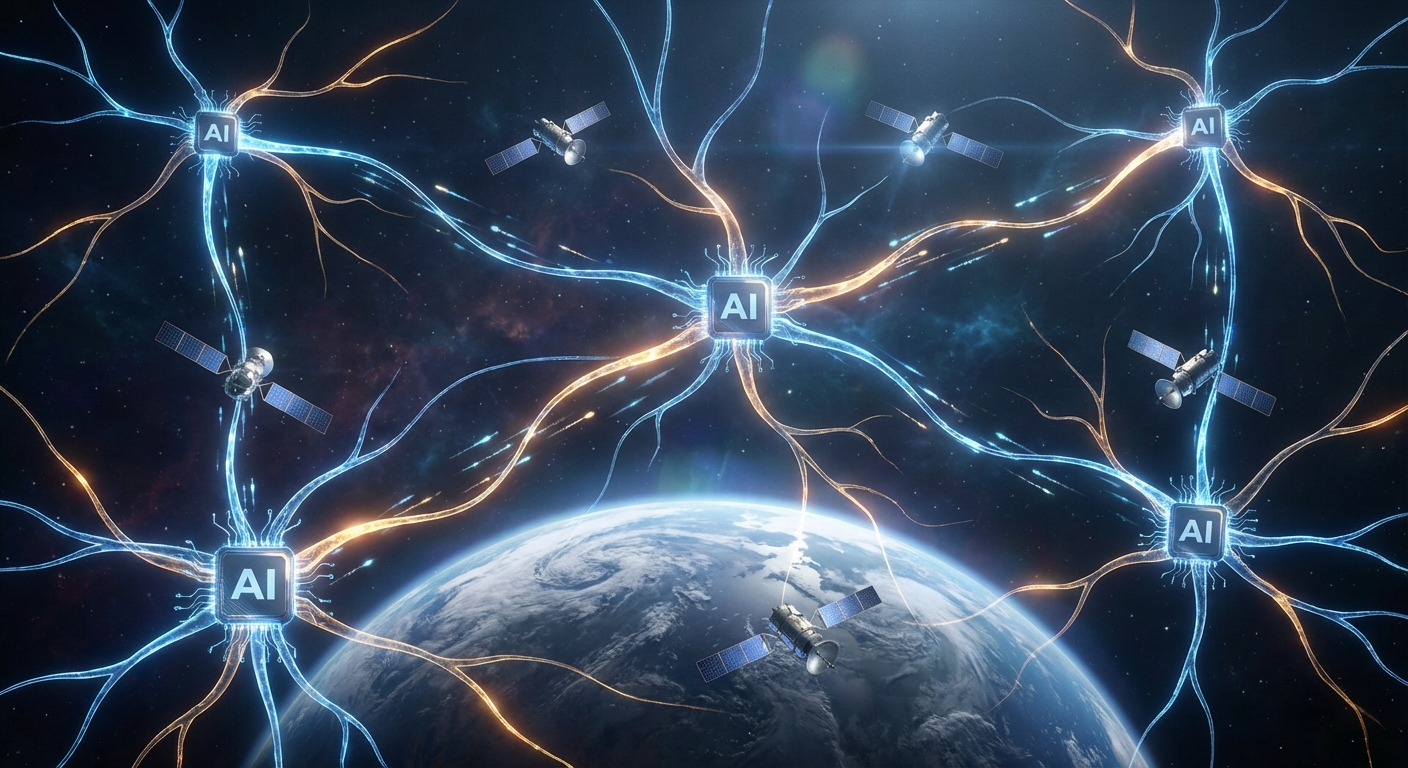
The reorganization is a precursor to the “Sentient Sun” strategy—moving massive AI compute clusters into orbit to bypass terrestrial energy and cooling limitations.
Grok Updates
Despite internal turmoil, Grok-3 (Beta) rolled out fully in early 2026, powered by the Colossus supercomputer (200,000 GPUs). xAI claims it beats Gemini and GPT-4o on major math and coding benchmarks.
Grok Imagine received a significant update on March 12th with “Extend from Frame”—chaining video clips together using the final frame of one as the start of the next, enabling sequences up to 15 seconds. The tool reportedly generated 1.2 billion videos in January 2026 alone.
ElevenLabs: The Creative Infrastructure Layer
ElevenLabs continued building out what’s becoming the “AWS of creative AI.”
Music Marketplace
On March 23rd, ElevenLabs launched Music Marketplace—a platform where musicians publish tracks created with Eleven Music and earn royalties when others remix or license them. This follows the Voice Marketplace, which has paid out over $11 million to creators.
Flows
Flows launched March 15th—a node-based visual workspace for building end-to-end creative pipelines. Users can chain 35+ different models (image, video, speech, music) on an infinite canvas with batch execution and non-destructive iteration. This transforms creative production from isolated asset generation into repeatable infrastructure.
Policy: The Federal Framework Arrives
White House National AI Policy
On March 20th, the White House introduced its first federal AI regulatory framework, emphasizing:
- Federal Preemption — Urging Congress to preempt “burdensome” state laws for national consistency
- Child Safety — Robust protections for children in AI systems
- Regulatory Sandboxes — Environments for industry experimentation under federal oversight
- Workforce Training — Initiatives for AI education to mitigate displacement
Global AI Summit
The fourth global AI summit was held in New Delhi in February, drawing 20+ heads of state and representatives from 100 countries. The focus shifted from theoretical safety to “Progress and Practical Implementation”—a tacit acknowledgment that AI change is “baked in” and the next decade will be defined by institutional adaptation.
Education Impact
Ethan Mollick spotlighted an OpenClaw tool called “Einstein” that autonomously completes and submits homework from student accounts. A Pew Research study shows over half of American teenagers now use AI for schoolwork. The consensus among educators: universities must shift focus from “linguistic polish” to the “substance of ideas.”
What’s Next
The pattern is unmistakable: March 2026 marks the transition from “AI assistants” to “AI workers.” The systems shipping now aren’t designed to chat—they’re designed to execute.
Key themes to watch:
- Subagent architectures become the default for complex tasks
- Computer Use capabilities expand beyond research preview
- Open-source coalitions challenge proprietary vertical integration
- Energy and infrastructure become the primary competitive battleground
- Policy frameworks scramble to keep pace with agentic capabilities
For builders: the tooling for autonomous agents is now mature enough for production. OpenClaw, Claude Code Channels, GPT-5.4 subagent patterns—the primitives are available.
For everyone else: the “agentic burden” is real. Managing systems that can act independently requires new organizational muscles. The question isn’t whether to adopt—it’s how to govern.
This roundup synthesizes publicly available announcements and documentation from mid-February through March 24, 2026. Links point to original sources where available.