
The AI education landscape has fundamentally shifted. If you’ve been watching from the sidelines, wondering when the right time to dive into AI training might be, that time is now—and it won’t cost you a dime to get started.
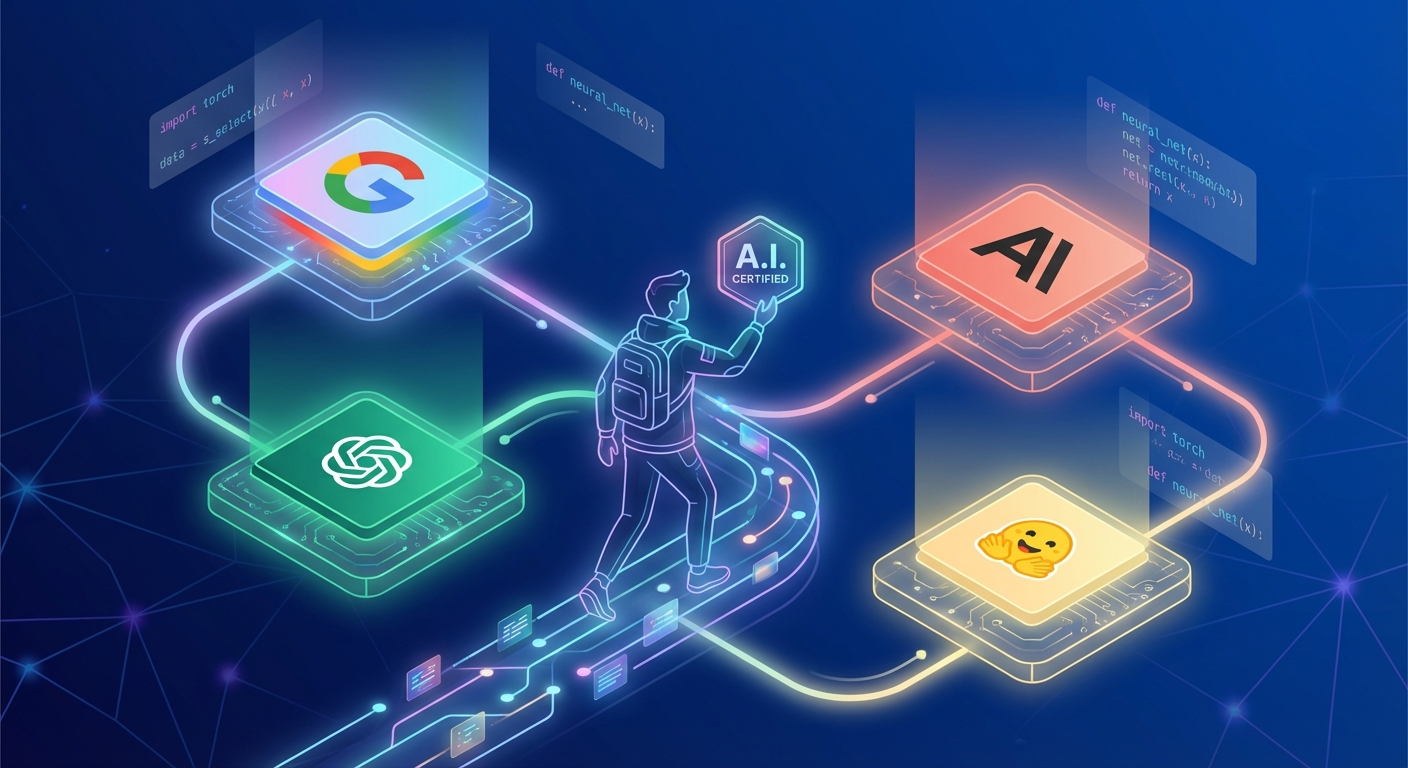
I recently came across a comprehensive analysis of the global AI training ecosystem as it stands in March 2026, and the findings are worth your attention. The major players—Google, OpenAI, Anthropic, and Hugging Face—have each carved out distinct educational pathways, moving far beyond the passive video courses of years past into something far more practical: in-model experiential learning where AI systems themselves serve as tutors, practice environments, and evaluators.
Here’s what you need to know about each provider’s approach and how to leverage these free resources for your career.
The Paradigm Shift: From Video to In-Model Learning
Before we dive into specifics, it’s worth understanding what’s changed. Traditional AI education meant watching hours of video content, maybe completing some exercises, and hoping the knowledge stuck. The 2026 model is different.
Today’s AI training emphasizes what industry analysts call the “Intelligence Layer”—the standardized integration of AI capabilities into enterprise cloud infrastructure. You’re not just learning about AI; you’re learning to architect systems that reason, plan, and execute tasks autonomously through protocols like the Model Context Protocol (MCP).
This isn’t theoretical anymore. These are job-ready skills that employers are actively seeking.
Google: The Infrastructure-First Approach
Google has positioned itself as the leader in “applied AI” education, and their strategy makes sense when you consider their broader cloud ecosystem. Their training pathways live primarily on two platforms: Skills.google and Google Cloud Skills Boost.
Starting Points for Beginners
If you’re new to AI, Google’s entry points are remarkably accessible:
Google AI Essentials remains the flagship beginner course. Completable in under ten hours, it focuses on immediate productivity gains without requiring technical background. The emphasis is on responsible usage and effective prompting—skills that translate directly to workplace efficiency.
Prompting Essentials takes this further with a structured five-step method for crafting powerful prompts. What makes this valuable isn’t just the technique—it’s the framework for building reusable prompt libraries for tools like Gemini.
Responsible AI Basics has evolved from theoretical ethics course to critical business requirement. With AI governance now front and center in enterprise decision-making, understanding Google’s seven AI principles and how to identify and mitigate bias isn’t optional—it’s foundational.
Technical Deep Dives on Cloud Skills Boost
For those ready to get technical, Google Cloud Skills Boost offers the Generative AI Learning Path—a professional-grade series that progresses from introductory concepts to advanced deployment of multi-agent systems on Vertex AI.
The standout offering is Generative AI Studio, which prioritizes hands-on experimentation over theory. You’re working directly with real-world prototyping tools, exploring prompt design, prompt tuning, and practical deployment. Completing these modules earns you skill badges and free certificates that carry genuine weight with recruiters.
Regional Programs Worth Noting
Google’s commitment extends beyond English-speaking markets. The Pathway to Prosperity program in Malaysia, delivered with UNITAR, focuses on data center operations and AI concepts for early- and mid-career professionals. In India, YUVA AI For All targets students and non-technical learners. These initiatives signal Google’s strategy: build AI literacy globally, and the platform adoption follows.
OpenAI Academy: The Model as Classroom
OpenAI’s educational approach is fundamentally different—and arguably more ambitious. The OpenAI Academy integrates learning directly into the ChatGPT interface, creating what they call “in-model” training.
AI Foundations: The Gateway Certification
The AI Foundations certification pathway is currently being piloted with major employers including Walmart, BCG, Accenture, and John Deere. This isn’t accidental—OpenAI designed the curriculum in direct consultation with these partners to ensure alignment with actual workforce needs.
The focus is practical: structured planning, summarization with citations, drafting professional workflows—all practiced within ChatGPT. Upon completion, certifications are verified by ETS and Credly, giving them the psychometric rigor employers trust.
OpenAI’s stated goal is ambitious: certify ten million Americans by 2030. Whether they hit that number or not, the trajectory is clear—AI literacy is becoming a baseline expectation.
Specialized Tracks
ChatGPT Foundations for Teachers deserves special mention. Available on Coursera and free for verified U.S. educators through June 2027, it helps K-12 teachers apply AI for lesson planning, rubric creation, and administrative efficiency. The full integration into a “ChatGPT for Teachers” experience is expected by late 2026.
For small businesses, the Dublin SME AI Accelerator Resource Hub provides structured guidance for integrating AI into operations, including workspace analytics and ready-to-use prompts for non-technical business leaders.
Developer Resources
Technical professionals aren’t forgotten. OpenAI Academy hosts regular webinars like Codex for Software Engineers and Introduction to Codex, covering first-pass research, legal-issue spotting, and code review automation. The resources on o1 and o3 models for complex reasoning tasks are particularly valuable for developers looking to automate multi-step workflows.
Anthropic: The Rise of the AI Architect
Anthropic’s educational contributions in 2026 mark a significant shift toward professional accreditation and standardized protocols for AI-tool interaction.
Claude Certified Architect – Foundations
On March 12, 2026, Anthropic launched their first professional accreditation: Claude Certified Architect – Foundations. This certification targets engineers and solution architects building production-grade applications with the Claude model family.
The certification signals something important about where the industry is heading. The ability to architect systems that reason and plan is now more valuable than the simple ability to generate text or code. This is no longer about prompt engineering—it’s about system design.
The Anthropic Academy
The Anthropic Academy, hosted on Skilljar, offers thirteen free, self-paced courses covering the full spectrum of AI engagement. Key offerings include:
- Claude 101 — Mastering daily work tasks with Claude
- AI Fluency: Framework & Foundations — Teaching the “4D framework” (Delegation, Description, Discernment, and Decision) for effective, ethical collaboration with any AI system
- Claude Code in Action — Integrating terminal-based AI into development workflows
- Building with the Claude API — End-to-end application development
- Intro to MCP — Connecting AI to external data and tools
The Model Context Protocol (MCP)
Anthropic’s training on MCP is perhaps its most significant technical contribution. MCP is presented as the “USB-C for AI applications”—a standardized protocol allowing AI models to connect seamlessly with external tools, data sources, and environments.
The Introduction to Model Context Protocol course teaches developers to build MCP servers and clients from scratch using Python. You’ll master the three core primitives—tools (executable functions), resources (read-only data), and prompts (templates)—to create modular, interoperable AI systems.
Masterclass in Prompt Engineering
Anthropic’s nine-chapter interactive prompt engineering tutorial remains one of the most respected free resources available. Available via Google Sheets or Jupyter Notebooks, it progresses from beginner techniques (clarity, directness, prompt anatomy) through intermediate methods (separating data from instructions to reduce hallucinations) to advanced approaches (XML tags for complex prompts, Chain-of-Thought prompting for reasoning transparency).
Hugging Face: Open-Source AI Education
In March 2026, Hugging Face remains the central hub for open-source AI education, providing specialized courses that emphasize the Transformers ecosystem and practical implementation of state-of-the-art models.
Comprehensive Deep Learning Paths
The Hugging Face “Learn” portal offers several high-impact courses, many community-driven and frequently updated:
The LLM Course — A detailed twelve-chapter curriculum introducing transformer models, tokenizers, and datasets before advancing to classical NLP tasks and reasoning models.
The Deep RL Course — A self-paced program on deep reinforcement learning where students can earn a certificate of honors by completing 100% of assignments on Google Colab.
The Agents Course — A specialized track for building and deploying AI agents that interact with external environments and tools.
The Robotics Course (LeRobot) — A groundbreaking curriculum teaching robot learning from classical foundations to modern approaches using the LeRobot library.
The Robotics Frontier: LeRobot
The Hugging Face Robotics Course represents a significant educational milestone, democratizing access to sophisticated robot learning techniques. The course uses the LeRobot library for intuitive dataset handling and pre-trained models, bridging the gap between simulation and real-world hardware deployment.
The March 2026 update (LeRobot v0.5.0) introduced full support for the Unitree G1 humanoid and “Real-Time Chunking” (RTC)—a technique that makes models dramatically more responsive by blending new predictions with in-progress actions.
Hugging Face MCP Course
Recognizing the importance of integration standards, Hugging Face launched its own MCP Course in collaboration with Anthropic. The certification process is entirely free:
- Certificate of Fundamentals — Complete the core theory units
- Certificate of Completion — Build and share a full application with the community
This modular approach lets both students and professionals upskill according to their specific needs.
Academic and Enterprise Resources
Stanford and MIT
Stanford’s CS224N (Natural Language Processing with Deep Learning) remains essential for language system builders. The 2026 version includes updated sections on pretraining (scaling, systems, data) and post-training (RLHF, SFT, DPO), covering alignment techniques for models like Llama 3 and GPT-5.
MIT’s How to AI (Almost) Anything explores cross-industry AI applications in art, medicine, and text, encouraging creative problem-solving and cross-disciplinary innovation.
Microsoft Virtual Training
Microsoft Learn offers free certifications and the Microsoft Credentials AI Challenge. The focus in March 2026 is on Microsoft 365 Copilot and Agents—through Virtual Training Days, professionals access sessions on securing AI agents, creating custom agents in Copilot Studio, and building verifiable credentials for LinkedIn.
NVIDIA and AWS
NVIDIA’s training platform offers free courses on Agentic AI, Conversational AI, and Data Science, with their NGC Catalog providing GPU-optimized software essential for high-performance applications.
AWS Academy provides foundational training including Generative AI for Executives and Foundations of Prompt Engineering for understanding AI business value and safe interaction with foundation models.
Choosing Your Path
With all these options, how do you decide? Here’s a practical framework:
Non-technical, wanting productivity gains: Start with Google AI Essentials and Prompting Essentials.
Developer building AI applications: Target OpenAI Academy’s technical tracks, Anthropic’s Claude Certified Architect, and Hugging Face’s specialized courses.
In education: OpenAI’s teacher-specific resources are purpose-built for your context—free through mid-2027.
Enterprise leadership: Google’s Responsible AI training plus OpenAI’s SME resources for practical implementation.
Open-source focused: Hugging Face’s learning paths offer the deepest dives into Transformers architecture and practical implementation.
Seeking recognized credentials: Google Cloud certificates and OpenAI’s ETS/Credly-verified certifications carry the most weight currently. Anthropic’s architect certification is increasingly valued for technical roles.
The Bottom Line
The democratization of AI education in 2026 represents a genuine opportunity. These aren’t watered-down courses designed to generate marketing leads—they’re professional-grade training designed to build real, marketable skills.
The shift from passive video learning to in-model experiential training means you’re not just learning about AI; you’re learning with AI, building intuitive understanding that only comes from practice.
Two trends stand out from this research. First, the Model Context Protocol represents a structural transition—a modular “Intelligence Layer” where models and tools can be swapped with minimal friction. Second, the “AI Architect” is emerging as a distinct, highly valued professional role requiring both technical skill (building MCP servers, prompt tuning) and architectural judgment (managing non-deterministic risks, optimizing for cost and persistence).
As models become more powerful and autonomous, the value shifts from “doing the task” to “orchestrating the system that does the task.”
Start with one course. Complete it. Then decide what’s next. The path from AI-curious to AI-proficient has never been more accessible.