

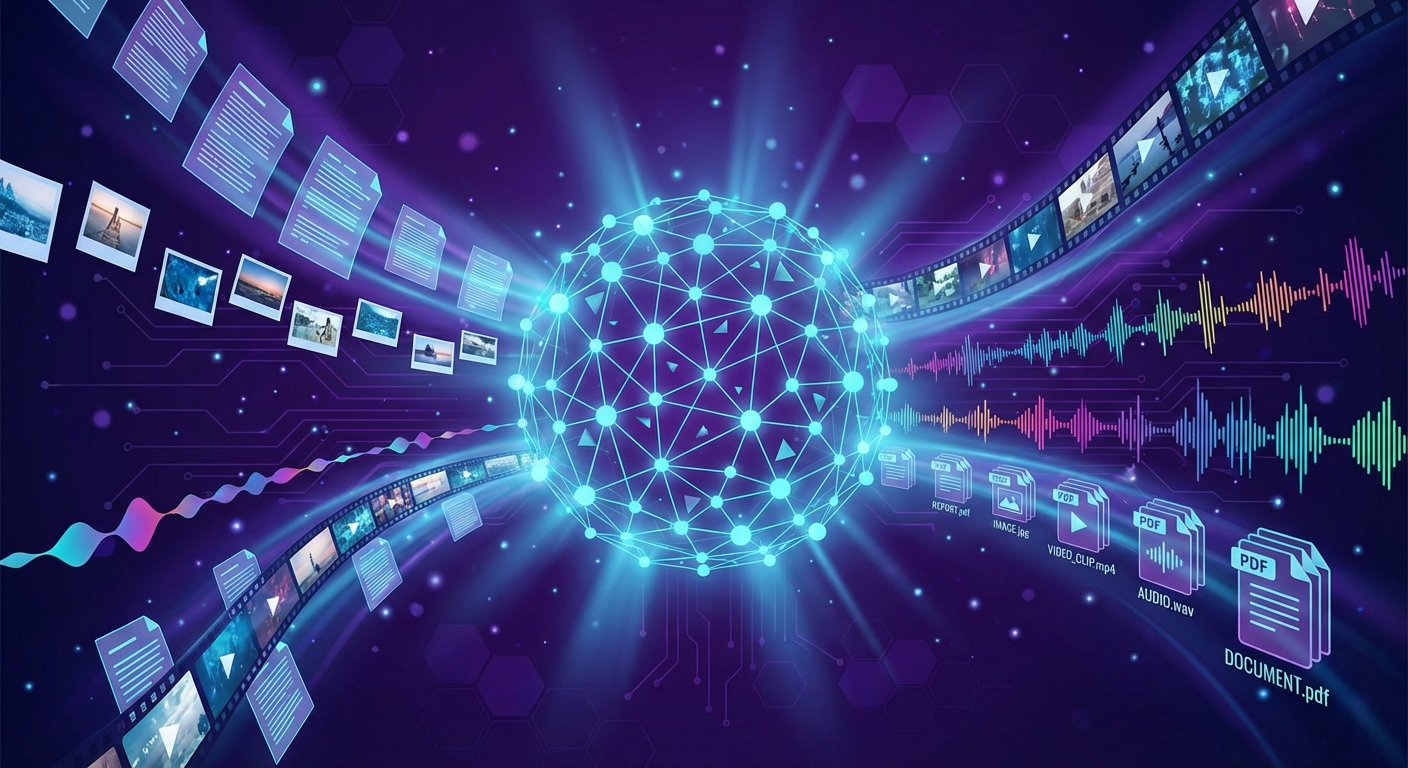
Google just dropped something that’s going to reshape how we think about embeddings. Gemini Embedding 2 is their first natively multimodal embedding model, and it’s now available in public preview through both the Gemini API and Vertex AI.
If you’ve been wrestling with the complexity of building multimodal search systems or RAG pipelines that need to understand more than just text, this is worth paying attention to. Let’s break down what makes this significant and what it means for developers.
The Multimodal Embedding Problem
Embeddings are the backbone of modern AI search and retrieval systems. They convert data into numerical vectors that capture semantic meaning, allowing machines to understand similarity between concepts rather than just matching keywords.
The challenge has always been modality silos. Text embeddings live in their own vector space. Image embeddings live in another. Audio in yet another. Building a system that can search across all of these meant maintaining separate embedding models, separate indices, and complex orchestration logic to combine results.
Gemini Embedding 2 eliminates this by mapping everything—text, images, video, audio, and documents—into a single, unified embedding space. That’s not just a convenience feature; it fundamentally changes what’s architecturally possible.
What Gemini Embedding 2 Actually Supports
The model handles an impressive range of inputs:
Text gets an expansive context window of up to 8,192 input tokens. That’s substantial room for detailed documents, long-form content, or complex queries.
Images can be processed up to six per request, supporting both PNG and JPEG formats. This enables batch comparisons and multi-image understanding in a single embedding call.
Video support extends to 120 seconds of content in MP4 and MOV formats. This opens up possibilities for video search and similarity matching that previously required separate specialized models.
Audio is handled natively—the model ingests and embeds audio data directly without requiring intermediate transcription steps. This is a significant architectural simplification for voice and audio applications.
Documents can be embedded directly as PDFs, up to six pages long. No more pre-processing pipelines to extract text before embedding.
But here’s where it gets interesting: Gemini Embedding 2 understands interleaved input. You can pass multiple modalities in a single request—say, an image paired with descriptive text—and the model captures the complex, nuanced relationships between them. This isn’t just parallel processing; it’s genuine multimodal understanding.
Flexible Dimensions with Matryoshka Learning
Like Google’s previous embedding models, Gemini Embedding 2 incorporates Matryoshka Representation Learning (MRL). This technique “nests” information by dynamically scaling down dimensions, giving developers control over the performance-storage tradeoff.
The default output dimension is 3,072, but you can scale down to 1,536 or 768 dimensions while maintaining quality. Google recommends these specific dimension choices for optimal results. This flexibility matters when you’re dealing with vector database storage costs at scale or need faster similarity calculations for real-time applications.
Multilingual by Design
Semantic understanding spans over 100 languages out of the box. For organizations operating globally or dealing with multilingual content, this eliminates the need for language-specific embedding models or translation preprocessing.
What This Enables
The practical applications here are significant:
Retrieval-Augmented Generation (RAG) gets substantially more powerful when your retrieval system can pull relevant context from documents, images, audio clips, and video segments—all from the same vector space. Imagine a customer support system that can retrieve relevant product images, previous call recordings, and documentation simultaneously based on a single query.
Semantic search across mixed-media libraries becomes straightforward. Search your company’s knowledge base with text queries and get back relevant slides from presentations, clips from training videos, and excerpts from recorded meetings.
Content clustering and organization works across modalities. Automatically group related content regardless of whether it’s a blog post, an infographic, or a podcast episode.
Sentiment analysis and classification can now operate on the actual audio of customer calls rather than just transcriptions, potentially capturing tonal nuances that text alone misses.
Getting Started
The model is available through both the Gemini API and Vertex AI. Here’s what a basic implementation looks like:
from google import genai
from google.genai import types

client = genai.Client()

with open("example.png", "rb") as f:
    image_bytes = f.read()

with open("sample.mp3", "rb") as f:
    audio_bytes = f.read()

# Embed text, image, and audio together
result = client.models.embed_content(
    model="gemini-embedding-2-preview",
    contents=[
        "What is the meaning of life?",
        types.Part.from_bytes(
            data=image_bytes,
            mime_type="image/png",
        ),
        types.Part.from_bytes(
            data=audio_bytes,
            mime_type="audio/mpeg",
        ),
    ],
)

print(result.embeddings)
The ecosystem integration is already solid. You can use Gemini Embedding 2 through LangChain, LlamaIndex, Haystack, Weaviate, QDrant, ChromaDB, and Vector Search. Google has also published interactive Colab notebooks for both the Gemini API and Vertex AI implementations.
The Bigger Picture
Embeddings are foundational infrastructure. They power search, recommendations, clustering, and increasingly, the context retrieval that makes large language models useful in production applications. A natively multimodal embedding model doesn’t just add features—it removes an entire category of architectural complexity.
Previously, building a multimodal RAG system meant:
- Multiple embedding models (text, image, audio, video)
- Multiple vector indices or careful index design for mixed types
- Orchestration logic to query across modalities
- Complex relevance scoring to combine results
With Gemini Embedding 2, all of that collapses into a single model call and a single vector space. The simplification is substantial, and simpler systems tend to be more reliable systems.
Conclusion
Gemini Embedding 2 represents a meaningful step forward in multimodal AI infrastructure. By unifying text, images, video, audio, and documents into a single embedding space, Google has removed a significant architectural hurdle for developers building sophisticated retrieval and search systems.
The model is available now in public preview. If you’re building anything that needs to understand relationships across different types of media—whether that’s a next-generation search engine, a multimodal RAG pipeline, or a content organization system—this is worth exploring.
Check out Google’s lightweight multimodal semantic search demo to see the embeddings in action, and dive into the documentation to start building.