

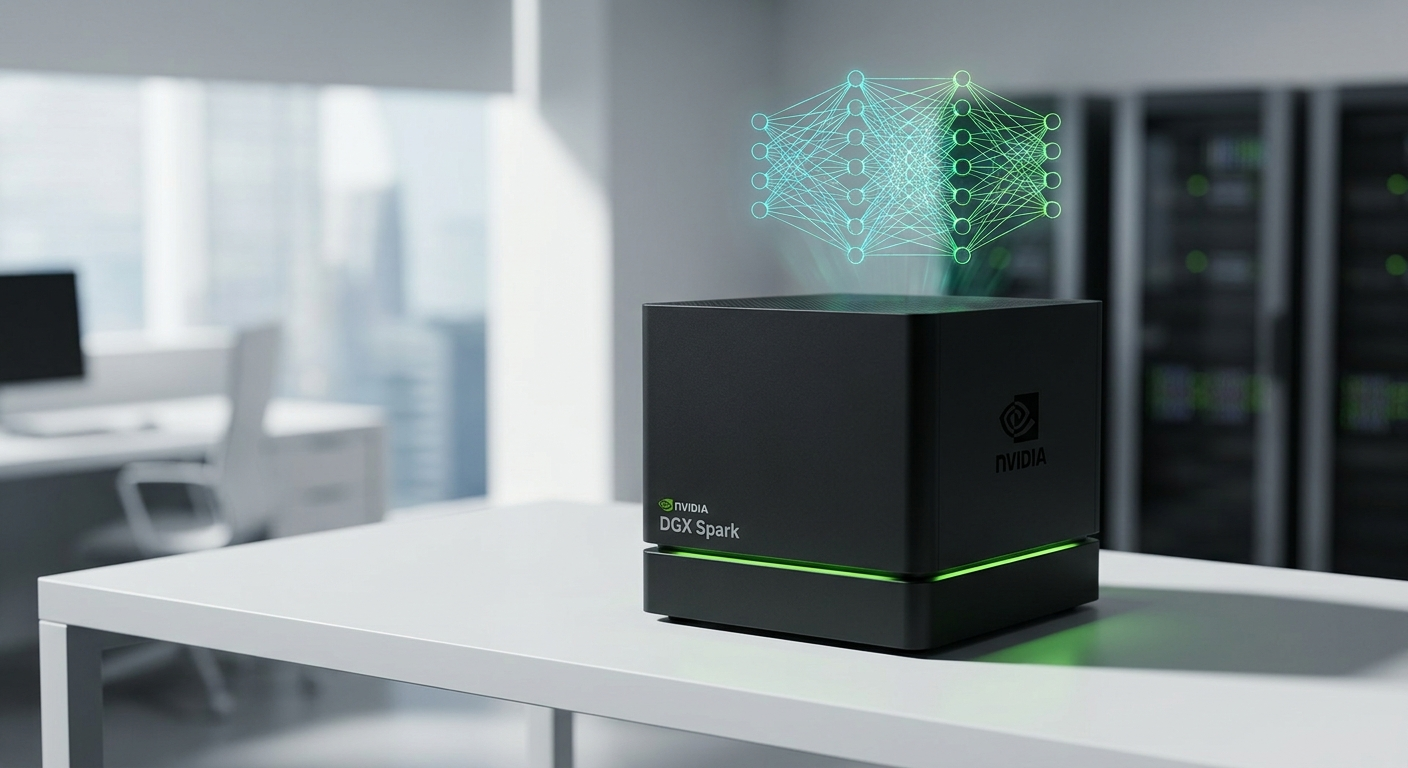
There’s a moment in every technology cycle where the impossible becomes merely expensive, and then suddenly accessible. For artificial intelligence development, that moment arrived with NVIDIA’s DGX Spark—a device that compresses data-center-grade AI infrastructure into something that fits on your desk and weighs about 1.2 kg—roughly the same as an ultrabook.
The DGX Spark, formerly known as Project DIGITS, represents a fundamental shift in how AI practitioners approach local development. Rather than treating cloud resources as the default and local hardware as a compromise, the Spark enables a “local-first” philosophy where frontier-scale models can be prototyped, fine-tuned, and deployed without ever leaving your premises.
In this deep dive, we’ll examine the architectural innovations that make this possible, the real-world performance characteristics that matter for production workflows, and the economic calculus that determines whether this $4,700 device makes sense for your organization.
The Grace Blackwell GB10: A Unified Approach to AI Computing
At the heart of the DGX Spark sits the NVIDIA GB10 Grace Blackwell Superchip—a system-on-chip that fundamentally rethinks the relationship between CPU and GPU in AI workloads.
Traditional architectures treat the central processor and graphics accelerator as separate entities, connected by the relatively narrow PCIe bus. This creates bottlenecks when moving data between CPU memory and GPU memory, forcing developers to carefully orchestrate data transfers to avoid performance penalties.
The GB10 eliminates this divide entirely. Using NVLink-C2C (Chip-to-Chip) technology, the CPU and GPU share a coherent 128GB pool of LPDDR5x memory with ultra-low-latency access. Both components see the same address space. There’s no copying back and forth.
The CPU complex combines 20 high-performance Arm cores in a dual-partition architecture: ten Cortex-X925 “performance” cores for heavy lifting and ten Cortex-A725 “efficiency” cores for background tasks. This heterogeneous design ensures the system can efficiently handle data ingestion, preprocessing, and pipeline orchestration while the Blackwell GPU focuses on the parallelized compute required for inference and training.
The Blackwell GPU itself packs 6,144 CUDA cores and fifth-generation Tensor Cores, delivering up to 1 PFLOP of performance at FP4 sparse precision. For context, that’s petaflop-scale AI compute in a device weighing 1.2 kg with a footprint of just 150mm × 150mm.
Memory: The Real Constraint in Modern AI
Here’s the uncomfortable truth about AI development in 2026: memory capacity matters more than raw compute throughput for most practical workloads.
Consumer-grade GPUs like the RTX 4090 or 5090 offer impressive TFLOPS numbers, but they’re capped at 24GB of VRAM. This creates what practitioners call the “vRAM wall”—the point where your model simply won’t fit, regardless of how fast your GPU might be. Models like Llama-3 70B or larger research architectures exceed this limit entirely.
The DGX Spark’s 128GB unified memory pool changes this equation. A single device can execute models with up to 200 billion parameters locally. When you stack two Sparks together via the 200Gbps QSFP ports, you get a virtual 256GB memory pool capable of running Llama 3.1 405B—a model that previously required a full rack of H100 servers.
But memory capacity tells only half the story. Memory bandwidth determines how fast tokens flow during inference, and this is where the Spark’s architecture shows its specific character.
The 273 GB/s bandwidth of LPDDR5x is a significant improvement over standard desktop RAM, but it’s notably lower than the High-Bandwidth Memory (HBM) found in data center GPUs or even the GDDR6X in high-end gaming cards. This creates a distinct performance profile during inference.
Understanding the Two-Phase Performance Model
Large language model inference operates in two distinct phases, and the DGX Spark excels at one while being merely competent at the other.
The prefill phase processes your entire prompt in parallel. It’s compute-bound—the system ingests tokens, runs attention calculations across the full context, and prepares the model state. The Blackwell architecture absolutely dominates here, achieving prompt processing speeds exceeding 1,700 tokens per second when using the NVFP4 (4-bit floating point) format.
The decode phase generates output tokens sequentially. Each new token requires a full pass of the model’s weights through the memory controller. This is memory-bound, and the Spark’s 273 GB/s bandwidth becomes the limiting factor. For a large 120B parameter model, token generation runs at approximately 38 tokens per second.
For comparison, a DIY rig with three RTX 3090s achieves 124 tokens per second during decode—roughly 3x faster. But that same DIY setup can’t match the Spark’s prefill performance, and it can’t run models larger than what fits in combined VRAM without elaborate quantization compromises.
The practical implication: the DGX Spark is optimized for processing massive contexts (up to 128k tokens) and running large models that wouldn’t fit elsewhere. It’s not the right tool if your primary use case is maximizing chatbot throughput for simple queries on small models.
Enterprise Software: The Hidden Value Proposition
Hardware specifications capture attention, but the software stack often determines whether a device succeeds in production environments. This is where NVIDIA’s enterprise DNA shows through.
The DGX Spark runs DGX OS, a customized Ubuntu 24.04 LTS distribution that’s far more than a driver bundle. It includes platform-specific optimizations, diagnostic tools, and pre-configured settings tailored for the GB10 hardware. Major updates arrive twice per year, with regular security patches maintaining compliance with FIPS and DISA-STIG standards.
More significantly, the system includes NVIDIA AI Enterprise—a software suite providing mission-critical support and a library of GPU-optimized containers, models, and frameworks. Work performed on the Spark—fine-tuning jobs, data pipelines, inference configurations—can be scaled directly to DGX H100 or B200 clusters in the cloud without environment-related friction.
The DGX Dashboard provides system telemetry monitoring and direct access to development environments like JupyterLab. NVIDIA Sync handles SSH tunnels and Tailscale connections for remote access. These aren’t flashy features, but they eliminate hours of configuration work that would otherwise consume engineering time.
For organizations already invested in NVIDIA’s ecosystem, this consistency matters. Your local development environment mirrors your cloud deployment environment. Code that works on the Spark works on your data center infrastructure.
The RAPIDS Connection: Why It’s Called “Spark”
The product name isn’t accidental. NVIDIA designed deep integration with Apache Spark, the dominant framework for scale-out data analytics—and for many enterprises, the biggest bottleneck in AI development isn’t model training but the massive ETL and data preprocessing workloads that precede it.
The RAPIDS Accelerator for Apache Spark functions as a plugin that integrates with Spark 3.0+ query planners. It identifies operations that can be parallelized on the GPU—joins, filters, aggregations—and offloads them to the cuDF library. This requires zero code changes. Legacy Spark applications run up to 5x faster on GPU-equipped systems without modification.
In production environments, the impact is substantial. Case studies show Fortune 100 retailers processing tens of terabytes of JSON data achieving 4x speedups and 80% infrastructure cost reductions compared to CPU-only clusters.
Project Aether, NVIDIA’s automation suite, takes this further. The TuneML component analyzes Spark job telemetry and automatically suggests configuration settings for peak performance. Migration times for large-scale data pipelines drop from months to days.
Power and Thermals: The 2026 Efficiency Breakthrough
Early DGX Spark units drew criticism for high idle power consumption and fan noise under load. The January and February 2026 software updates addressed this dramatically.
The culprit was the ConnectX-7 SmartNIC—an exotic networking component drawing significant power even when idle. NVIDIA implemented “hot-plug detection” that dynamically powers down the NIC when not in use. The result: idle power consumption dropped from 37W to 22W in headless mode, a 32%+ reduction.
Under AI workloads, the system draws approximately 140W—well within the 240W capacity of the external adapter. Despite the compact chassis, professional testing confirms no thermal throttling during sustained 24-hour training runs. The device gets warm to the touch but maintains consistent performance.
For deployment in secure or air-gapped environments, the UEFI provides granular hardware control. Wi-Fi and Bluetooth can be completely disabled at the firmware level. PXE boot configurations facilitate remote reimaging of Spark clusters over the network.
Competitive Positioning: Where the Spark Fits
The DGX Spark enters a market with several meaningful alternatives, each offering different tradeoffs.
Dell Pro Max with GB10 uses identical hardware—same GB10 superchip, same 128GB memory, same ConnectX-7 networking—but is sold and supported through Dell’s professional channels at a slightly lower price point (~$4,139 vs $4,699). Early benchmarks showed marginally higher idle power draw before the 2026 software updates brought parity.
AMD Ryzen AI Max+ “Strix Halo” offers a much lower entry price (~$1,800-$2,300) and comparable token generation speeds for smaller models. However, it lacks the Spark’s prefill performance and doesn’t support the CUDA ecosystem that remains the primary requirement for most modern AI research and enterprise tools.
Apple Mac Studio (M4 Ultra) delivers superior memory bandwidth (800+ GB/s) for better token generation throughput. But it runs macOS, not the Linux environment that mirrors production cloud deployments, and it lacks the CUDA compatibility that most AI frameworks require.
The Spark’s positioning is specific: developers who need to mirror their production cloud environments—which are almost universally NVIDIA GPUs on Linux—while working with models that exceed consumer GPU memory limits.
Scaling Beyond a Single Device
The 200Gbps QSFP ports enable “Spark Stacking”—connecting multiple units into a virtual supercomputer with incrementally scaled capabilities.
Two nodes connected directly via QSFP cable create a 256GB memory pool, enabling local execution of models like Llama 3.1 405B. Three nodes in a ring topology handle distributed fine-tuning or small training jobs. Four nodes through a RoCE switch manage models up to 700 billion parameters.
Performance scaling isn’t always linear for inference—inter-node communication latency affects sequential token generation. But for reinforcement learning tasks or distributed data-parallel fine-tuning, scaling approaches linear, providing significant throughput gains.
The Economic Argument
At $4,699, the DGX Spark is expensive for an individual but potentially transformative for organizations paying ongoing cloud compute costs.
The hidden costs of cloud AI development add up: data egress fees, storage costs, “cold-start” waste from cluster provisioning. In ETL scenarios where engineers run frequent small jobs throughout the day, platforms like Databricks or AWS EMR can spend 50-60% of billed time just spinning up clusters.
The Spark eliminates this overhead. Compute is instant. Data never leaves the premises. There are no egress fees, no cold starts, no surprise bills at month end.
The inclusion of NVIDIA AI Enterprise licensing and 3-year warranty (on OEM systems like the Dell Pro Max) provides institutional security that DIY consumer rigs can’t match. For regulated industries or organizations handling sensitive data, the compliance story matters.
Who Should Care
The DGX Spark isn’t for everyone. It’s not the right choice if you’re running simple inference on small models where consumer GPUs suffice. It’s not optimal if your primary metric is maximum token generation speed rather than model capacity.
But for AI researchers working with frontier-scale models, data scientists processing massive contexts, or enterprises that need to keep sensitive data and proprietary logic on-premise—the Spark represents something genuinely new. One petaflop of AI compute. 128GB of unified memory. Enterprise-grade software. 1.2 kilograms.
From the South Pole’s IceCube Neutrino Observatory analyzing observation data to medical researchers training CNNs on high-resolution CT scans, the device has found homes where its specific capabilities—large memory, moderate bandwidth, excellent prefill performance, enterprise software stack—align with real-world requirements.
The trajectory of AI development has reached a point where data center capabilities increasingly fit on desks. The DGX Spark is what that looks like in practice: not a compromise, but a different tool for a specific set of problems that previously required cloud resources or elaborate multi-GPU configurations.
For organizations where those problems are real, it’s worth the investment.