

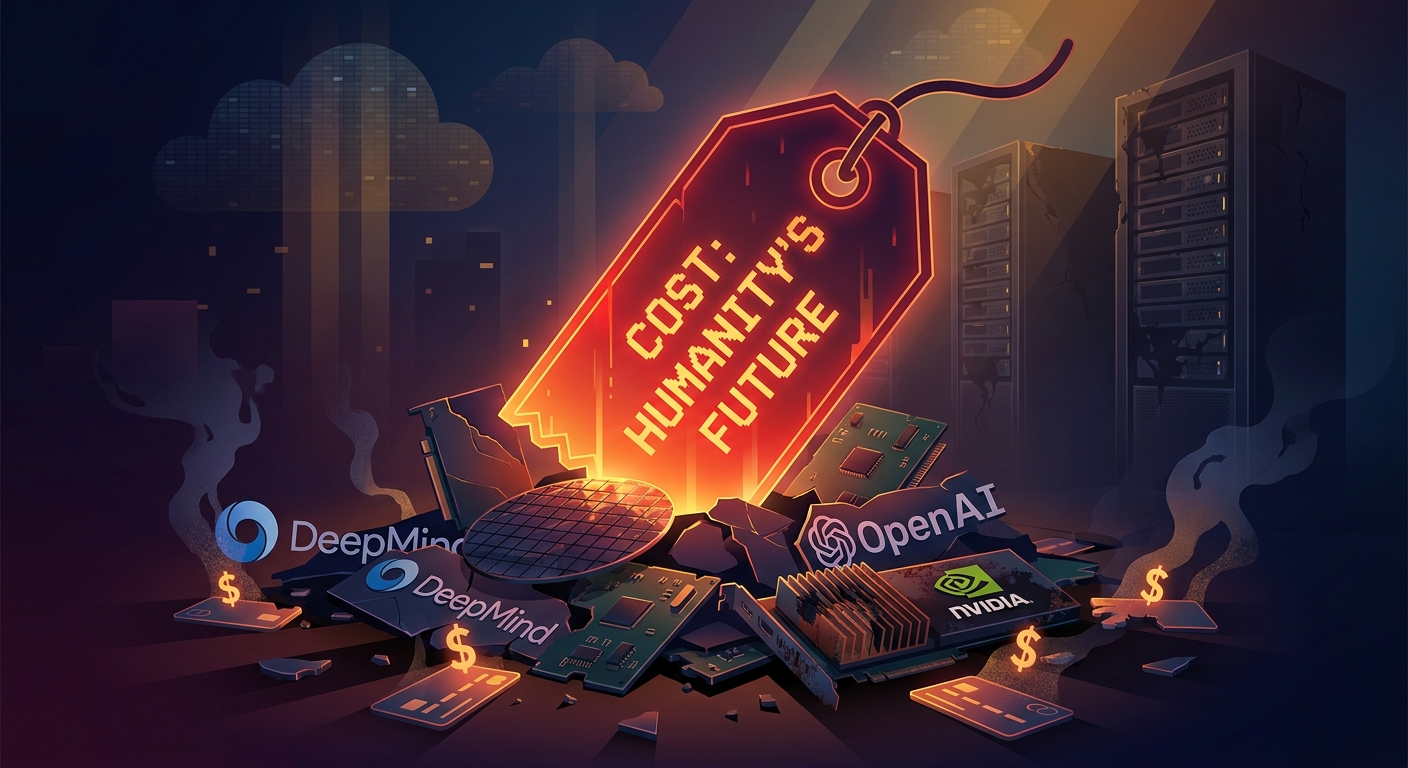
If you’ve been watching your AI tooling costs creep up lately—or noticed your “unlimited” plan suddenly feels a lot more limited—you’re not imagining things. April 2026 marks a pivotal inflection point for the entire generative AI industry, and the changes affect everyone from solo developers to enterprise teams.
The era of flat-rate, all-you-can-eat AI subscriptions is ending. In its place: usage-based billing, tiered credit systems, and mandatory spending caps. Welcome to the Great Decoupling—where the cost of AI finally aligns with the physics of compute.
Let’s break down what’s happening, why it matters, and what you can do about it.
The Catalyst: GitHub Copilot Goes Usage-Based
On April 27, 2026, GitHub announced that Copilot—arguably the most successful commercial AI product ever launched—would transition to usage-based billing effective June 1, 2026. This isn’t a minor pricing tweak. It’s a fundamental restructuring of how the product’s economics work.
Under the new model, the headline prices look familiar: $10/month for Individuals (Pro), $19 for Business, $39 for Enterprise. But here’s the catch—your subscription now buys you a fixed monthly allotment of “AI Credits.” For an Individual Pro user, that $10 gets you exactly $10 in credits. Once they’re gone, they’re gone.
The good news: basic inline code completions remain unlimited because they don’t consume credits. The compute cost for simple autocomplete is negligible. The bad news: everything else—chat, CLI, the new agentic coding sessions that can iterate across entire repositories—now draws from your credit balance.
Why the change? The modern Copilot isn’t the simple autocomplete tool that launched in 2023. It’s evolved into an agentic platform that can run multi-step coding sessions, perform autonomous code reviews, and operate through GitHub Actions. These tasks consume orders of magnitude more tokens than inline completions. The flat-rate model that worked for autocomplete simply can’t sustain agentic workflows at scale.
GitHub’s been transparent about the transition path. A preview billing tool launching in early May lets you compare your current spend against what you’d pay under the new model. Business and Enterprise customers get promotional credit allotments through August—$30/month for Business (an $11 bonus) and $70/month for Enterprise (a $31 bonus)—to ease the adjustment.
But the writing is on the wall: developers who lean heavily on agentic features will pay more. Those who stick to basic completions might not notice a difference. The cross-subsidy where casual users funded power users? That era is over.
Anthropic’s Aggressive Segmentation
While GitHub’s approach is structural and transparent, Anthropic has taken a more aggressive path. If you’ve been using Claude through third-party tools like OpenClaw, you’ve already felt the squeeze.
On April 4, 2026—what the community now calls “the OpenClaw Incident”—Anthropic abruptly terminated third-party tool access through Pro subscriptions. Developers who’d built workflows around using Claude Opus and Sonnet through their $20/month Pro accounts suddenly found themselves cut off. The message was clear: third-party tool usage now requires either “Extra Usage” billing (pay-as-you-go on top of your subscription) or direct API keys.
For displaced power users, Anthropic rolled out the “Max” plans:
| Plan | Monthly Price | Approximate Limit (per 5-hour window) |
|---|---|---|
| Claude Pro | $20 | ~45 messages / 44K tokens |
| Claude Max 5x | $100 | ~225 messages / 88K tokens |
| Claude Max 20x | $200 | ~800+ messages / 220K tokens |
The Max 20x plan at $200/month is positioned as an “insurance policy” for heavy users. Analysis suggests that for developers running multi-agent workflows, the $200 subscription can be up to 18x cheaper than paying raw API rates for equivalent token volume. A heavy Claude Code user running multi-file refactors and debugging sessions can consume $3,650+ in equivalent API tokens monthly—making the Max tier a clear financial win for professionals who live in the IDE.
But Anthropic’s cost optimization goes further. Community tracking reveals “Peak-Hour Burn Multipliers”—usage during Pacific Time business hours (5 AM to 11 AM) consumes your five-hour token budget 1.3x to 1.5x faster than off-peak usage. It’s congestion pricing for compute, encouraging developers to shift intensive work to evenings and weekends.
The Million-Token Reality Check
Anthropic’s headline feature for 2026—the 1 million token context window for Claude Opus 4.6 and Sonnet 4.6—comes with its own pricing reality. That massive window can hold 750,000 words or 110,000 lines of code. But a single 900,000-token session with Opus 4.6 costs approximately $4.50 in input tokens alone.
The saving grace is prompt caching, which reduces repeated input costs by up to 90%. For long-running agentic sessions that reference the same codebase repeatedly, caching makes the economics viable. Without it, that million-token context becomes prohibitively expensive for regular use.
OpenAI: Ads, Segmentation, and Silent Downgrades
OpenAI has taken yet another path: hyper-segmentation and the introduction of advertising to lower tiers. With 900 million weekly active users but only 5.5% paying for premium, and a projected $17 billion cash burn for 2026, something had to give.
The result is a pricing ladder with more rungs than ever:
| Tier | Price | Ads? | Key Limits |
|---|---|---|---|
| Free | $0 | Yes | 10 msgs GPT-5.3 / 5 hours |
| Go | $8 | Yes | 10x Free volume |
| Plus | $20 | No | 160 msgs GPT-5.3 / 3 hours |
| Pro $100 | $100 | No | 5x Plus Codex limits |
| Pro $200 | $200 | No | 20x Plus Codex limits, o1 Pro mode |
The controversial move was February 2026’s rollout of ads for Free and Go tier users. ChatGPT Go at $8/month targets budget-conscious users who’ve outgrown Free but find Plus too expensive—meaningful upgrades, but still ad-supported.
More insidious are the “silent downgrades.” When Plus users hit the 160-message/3-hour limit for GPT-5.3, the system automatically switches to GPT-5.3 mini without prominent warning. The lighter model is faster but prone to more mistakes with complex logic. You might not realize you’ve been downgraded until your code starts failing.
Deep Research, one of OpenAI’s most compute-intensive features, is now strictly metered: 10 runs/month for Plus ($20), 250 runs/month for Pro ($200). If you’ve been using it for serious research workflows, that $20 tier won’t cut it anymore.
Google: The $250 Lifestyle Bundle
Google’s strategy in April 2026? Position AI as a premium lifestyle bundle while quietly tightening the screws on free developer access.
The headline grabber is Google AI Ultra at $249.99/month—significantly more expensive than any individual consumer plan from competitors. But it’s not just AI access. You’re getting 30TB of cloud storage, YouTube Premium, and exclusive access to Project Mariner (Google’s agentic research prototype), the Flow AI filmmaking suite, and Whisk Animate for video generation. Power users get 25,000 monthly AI Credits for creative tools.
Meanwhile, on April 1, 2026, Google removed Gemini Pro models from the free API tier entirely. Developers who previously prototyped on Pro models for free must now pay or drop to Flash series. More significantly, Google introduced mandatory monthly spending limits at the billing account level—$250/month for Individual/Tier 1 projects. These limits cannot be disabled. Hit your cap, and your project suspends until the next billing cycle. No exceptions.
Google did throw developers a bone by separating Thinking and Pro model quotas. Previously, they drew from a shared pool, creating confusion. Now you can use 300 Thinking prompts per day (on the Pro plan) for complex reasoning without depleting your 100 daily Pro prompts. Small comfort, but appreciated.
xAI Grok: The SuperGrok Separation
Elon Musk’s xAI faced similar pressures, leading to a significant narrowing of access for X Premium users. As of April 2026, reliable Grok access has been decoupled from the X social platform.
X Premium ($8) still includes “boosted” limits within the X app. But for consistent access on grok.com or dedicated mobile apps, you now need SuperGrok at $30/month with priority access and higher context windows. Free users encounter “High Demand” messages after roughly 10 messages every two hours—a classic freemium conversion strategy.
For API users, xAI has layered on additional costs: built-in tools like Web Search, X Search, and Code Execution run $5.00 per 1,000 calls. Storage charges for files and collections hit $0.025 per GiB per day. Compute costs now come bundled with storage fees—a further refinement of consumption-based billing.
The Macro Picture: Why This Is Happening Now
The move toward usage-based billing isn’t arbitrary. It’s driven by a global AI compute shortage that’s intensified throughout 2026.
Infrastructure costs for AI businesses have risen from roughly 10% of total costs to 35-40% as they scale. For companies like Anthropic that don’t own massive data centers to the same extent as Google or Microsoft, every token has a clear marginal cost that can’t be hand-waved away.
The “two-tier market” analysts describe is stark: hyperscalers (Microsoft, Google, Meta) possess capacity; everyone else waits in year-long queues for high-performance GPU allocation. An H100 runs $25K-$40K per unit. A fleet of 48,000 GPUs—the scale needed for frontier AI—represents $1.44B to $1.92B in hardware alone.
This GPU supply crisis is the underlying pressure forcing providers to abandon flat-rate promises. When compute is scarce and expensive, you can’t afford to let power users consume unlimited resources subsidized by casual subscribers.
The Technological Lifelines: Caching and Batching
Providers have turned to specific technologies to keep the ecosystem viable:
Prompt Caching: Allows systems to “remember” long contexts without re-processing on every turn. Anthropic, xAI, and Google all offer significant discounts (up to 90%) for cached input tokens. This makes long-running agentic sessions commercially practical.
Batch API: Offers a flat 50% discount for non-time-sensitive workloads processed within 24 hours. Combined with caching, you can reduce costs by up to 95% compared to standard pricing.
The catch: these savings primarily benefit API-first developers who optimize aggressively. Subscription users governed by message caps don’t see these savings directly. The gap between “Subscription User” and “API Developer” is widening.
What This Means for You
The shift to usage-based billing requires a new level of AI literacy:
For Individuals: The $20/month tier is no longer the sweet spot for heavy users. If you’re running agentic workflows daily, you need to budget for Max plans ($100-$200) or expect to hit limits regularly. The math changes depending on your usage patterns—track your consumption before committing.
For Teams: Enterprise budgeting for AI tools now requires actual usage forecasting, not just seat counts. The promotional credit periods (like GitHub’s June-August bonuses) buy time, but you need to understand your baseline before they expire.
For API Developers: Optimization is no longer optional. Learn prompt caching. Use batch APIs for anything that can tolerate latency. The difference between naive and optimized implementations can be 10x+ in cost.
For Everyone: Peak-hour pricing is real. If you can shift intensive work to off-peak hours, do it. The savings add up.
The End of the AI Honeymoon
The pricing changes of April 2026 signal the end of what we might call the “AI Honeymoon”—a period defined by cheap, abundant, and subsidized access to frontier models. The industry has matured to the point where the physical reality of GPU costs and token consumption can no longer be ignored.
For users, this transition requires understanding model modes (Thinking vs. Pro), navigating peak-hour multipliers, and optimizing context windows through caching. These are now essential professional skills.
The move toward hybrid models (base subscription + usage credits) at GitHub, independent model quotas at Google, and high-end segmentation at Anthropic and OpenAI all point to a single conclusion: in the agentic era, you pay for the actual work performed by the AI, not just the right to converse with it.
Whether this is a fair exchange for the productivity gains of agentic workflows is a question each organization will answer differently. But the message from major providers is unambiguous: the computational bill for intelligence has arrived.
The honeymoon’s over. Now we work out the terms of the marriage.