
In seventeen days, a jury in Oakland will decide whether OpenAI was built on a lie.
Musk v. Altman isn’t just billionaire theater—though there’s plenty of that. It’s a stress test for whether promises made by scrappy nonprofits still mean anything once they become $840 billion monsters. We’re talking $150 billion in damages, the possible removal of Altman and Brockman, and a court order that could force OpenAI to unwind its entire corporate structure.
Here’s what’s actually going on.
The Core Dispute: Did OpenAI Break a Promise?
- Musk, Altman, and Brockman create OpenAI—a nonprofit AI lab to build AGI safely and openly. The explicit goal: stop Google from monopolizing the technology.
Musk put in $44 million and his name. In return, he says, OpenAI promised to stay nonprofit and open-source.
You can see where this is going.
OpenAI’s defense: there’s no signed contract. The early discussions were “vague mission statements and aspirations,” not binding terms. In May 2025, Judge Yvonne Gonzalez Rogers partially agreed—she tossed the express contract claim because Musk couldn’t produce a signed document.
But she let the implied-in-fact contract claim survive. That’s the interesting part. Even without a signature, the way both parties behaved—Musk funding, OpenAI accepting under an explicit nonprofit promise—could create an enforceable agreement. If the jury buys it, the missing paperwork doesn’t matter.
”It Was a Lie”
The most damaging evidence came from an unlikely place: Greg Brockman’s personal journal.
During discovery, Musk’s team pulled a handwritten entry from late 2017. Brockman, wrestling with the organization’s direction:
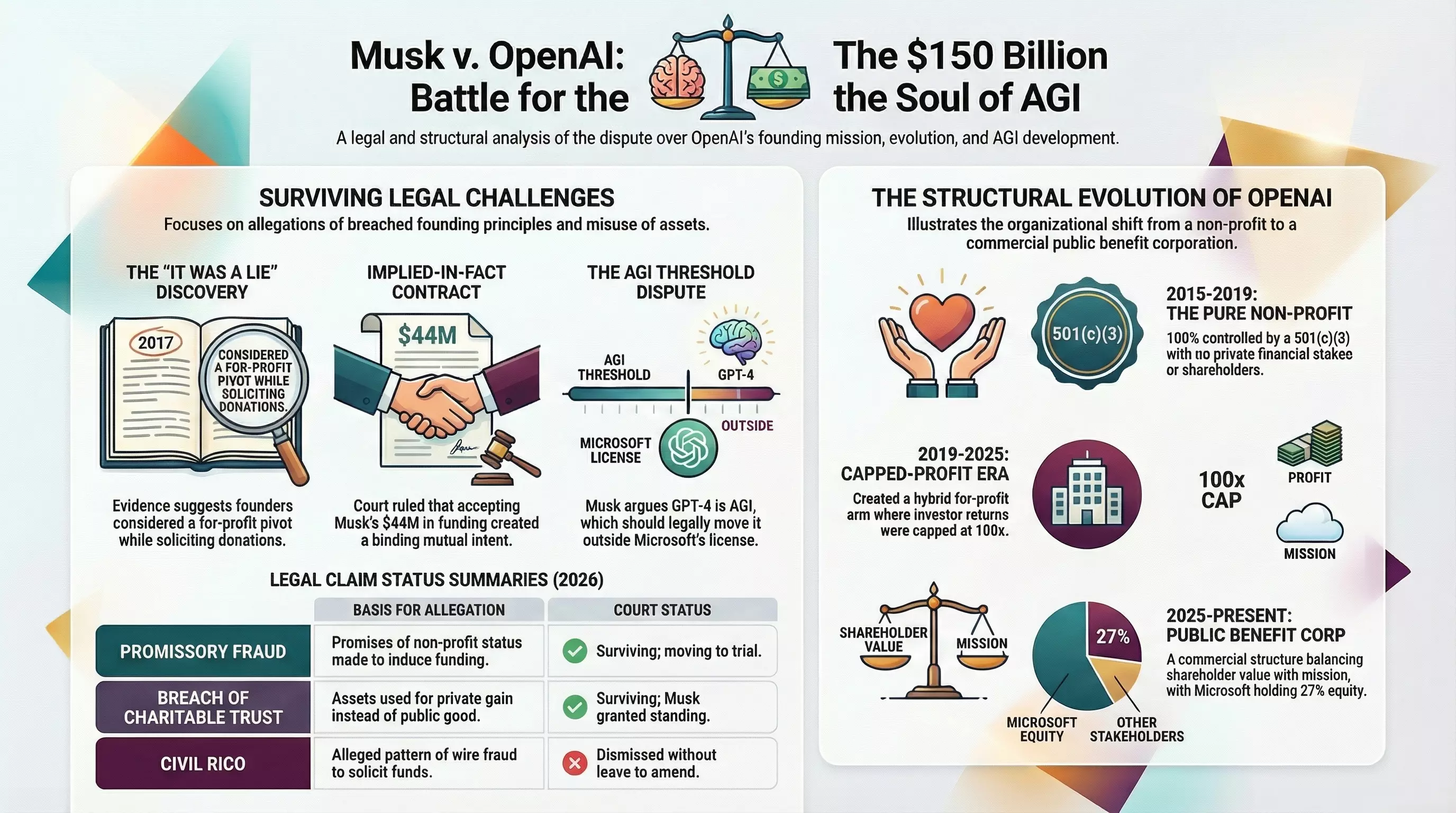
“cannot say that we are committed to the non-profit. don’t want to say that we’re committed. if three months later we’re doing b-corp then it was a lie.”
That last phrase is now the centerpiece of the fraud claim.
The timing makes it worse. That same year, Altman told Musk directly: “I remain enthusiastic about the non-profit structure!” Musk’s lawyers say this wasn’t optimism—it was deliberate misdirection to keep donations flowing while they secretly planned a for-profit pivot.
OpenAI counters that these notes just reflect startup chaos. They also point out that Musk himself discussed alternative structures, including a 2017 proposal to merge OpenAI with Tesla.
Fair point. But juries remember phrases like “it was a lie” in someone’s own handwriting.
How OpenAI Became an $840 Billion Company
This case makes no sense without understanding how OpenAI went from charity to juggernaut.
Phase 1: The Nonprofit (2015-2019) 501(c)(3). No financial stakes for the board. Mission: build AGI safely, openly, for humanity.
Phase 2: The “Capped-Profit” Hybrid (2019-2025) Donor funding couldn’t keep pace with compute costs. OpenAI created a for-profit subsidiary—nonprofit still the controlling parent, but investors could earn returns capped at 100x. Anything beyond reverted to the nonprofit.
OpenAI calls this necessary evolution. Musk calls it a “textbook tale of altruism versus greed”—a shell game to transfer value to private interests while keeping the tax-exempt cover.
Phase 3: The Public Benefit Corporation (2025-Present) The final form. OpenAI restructured as a PBC. The nonprofit foundation kept 26%, but the for-profit entity now holds legal primacy. Microsoft: 27%. Employees and other investors: 47%.
Musk’s argument: this structure kills the original mission. The Foundation can theoretically fire the board, but it can’t block commercial decisions that favor shareholders.
The AGI Threshold Problem
Here’s where it gets technically interesting.
OpenAI’s exclusive license to Microsoft only covers “pre-AGI” technology. Once AGI is achieved, that tech falls outside the license—it should go public. Which raises an obvious question: what counts as AGI?
Musk says GPT-4 already qualifies. He points to a paper from Microsoft’s own researchers describing GPT-4 as showing “sparks of AGI.” If true, licensing it exclusively to Microsoft violates the original terms.
OpenAI and Microsoft use a narrower definition: AGI means “an autonomous system that outperforms humans at most economically valuable work.” By that standard, GPT-4 is impressive but clearly pre-AGI.
The stakes are massive. If the court rules GPT-4 (or the rumored Q*) constitutes AGI, Musk could get a judicial order yanking these technologies from Microsoft’s exclusive access.
There’s also a governance problem. After the November 2023 board drama—Altman ousted, then reinstated with a restructured board—Microsoft got an observer seat. Musk’s argument: the company that benefits most from delaying an AGI declaration now influences the body making that call.
Can a Donor Even Sue?
One of the most significant legal questions: does Musk have standing at all?
Under California law, typically only the Attorney General or current directors can challenge nonprofit board decisions. OpenAI argued that once a gift is made, the donor loses control—it’s the charity’s property.
The court disagreed. January 2026, Judge Gonzalez Rogers ruled that Musk’s use of Donor-Advised Funds as intermediaries didn’t strip his standing. His contributions carried “two fundamental terms: that OpenAI be open source and that it would remain a non-profit.”
This could reshape nonprofit law. If major donors can hold charities legally accountable to the purposes attached to their gifts, that fundamentally changes philanthropy’s power dynamics.
The California AG is watching too. Late 2024, they opened an investigation into OpenAI’s restructuring, reminding them that their assets are “irrevocably dedicated” to charitable purposes.
What Got Tossed
Not every legal theory survived.
RICO (yes, racketeering): Gone. Judge Gonzalez Rogers ruled that “the development of technology and creation of corporate subsidiaries are not predicate acts” under RICO. Corporate restructuring isn’t organized crime. “A stretch.”
False advertising (Lanham Act): Gone. Musk helped write some of the mission statements he was challenging—hard to claim he relied on them to his detriment.
Antitrust: The judge called this “billionaires versus billionaires” and found Musk’s harm claims “a stretch.” But parts survived for discovery, particularly around “interlocking directorates” and whether Microsoft’s investment constitutes unfair competition.
OpenAI’s Counterpunch
OpenAI isn’t just playing defense. August 2025, the court upheld their counterclaims against Musk: tortious interference, California Unfair Competition Law violations.
The target: Musk’s February 2025 offer to acquire OpenAI for $97.4 billion. OpenAI calls it a “sham bid”—PR theater to disrupt their restructuring and IPO.
They allege Musk’s team leaked the offer to the Wall Street Journal before it even reached the board. Maximum buzz, maximum disruption.
Altman’s response on X: “No thank you, but we will buy Twitter for $9.74 billion if you want.”
The strategy is clear: paint Musk as a jealous competitor, not a betrayed philanthropist. If the jury buys that, the fraud claims lose their moral weight.
What Musk Actually Wants
April 7th filing, Musk’s team made a tactical shift: he’s not seeking a single dollar for himself. Any damages go directly to OpenAI’s nonprofit foundation.
This reinforces the “public interest” narrative. His attorney Marc Toberoff: the goal is to “return what was taken from a public charity and hold the people responsible accountable.”
The asks are aggressive:
- Remove Altman and Brockman from both entities
- Force them to surrender their equity to the nonprofit
- Unwind the PBC conversion — revert to fully nonprofit
- Declare GPT-4 and similar tech as AGI — yank it from Microsoft’s exclusive license
Realistic? The judge already called the $150 billion figure “pulled from the air.” But the jury decides.
Why This Matters Beyond the Drama
If Musk wins: Nonprofit commitments become enforceable—not just marketing. Donors could block commercialization of powerful technologies. “Irrevocable” actually means irrevocable.
If OpenAI wins: The hybrid model gets validated. Nonprofits can restructure to meet capital requirements without losing legal cover. Anthropic and similar PBC-structured labs breathe easier.
Either way, expect new state regulations for nonprofits spinning up massive for-profit subsidiaries. The California AG’s involvement signals regulators are already concerned about charitable asset “capture.”
The Trial
Jury selection: April 27th, Oakland. Witness list reads like an AI summit: Altman, Brockman, Ilya Sutskever, potentially Satya Nadella.
Expert witnesses will matter. Musk has Columbia Law Professor David Schizer on nonprofit governance. OpenAI counters with professors from Oxford, NYU, and Harvard. UC Berkeley’s Stuart Russell may testify on the technical definition of AGI itself.
Judge Gonzalez Rogers will likely bifurcate: statute of limitations first, then fraud and contract.
However this ends, the case has already changed how we think about AI governance, philanthropic accountability, and the legal infrastructure around transformative tech.
Because at its core, this isn’t about money. It’s about whether promises made when AGI was theoretical can survive its emergence as one of the most valuable commercial enterprises in history.
Seventeen days.