

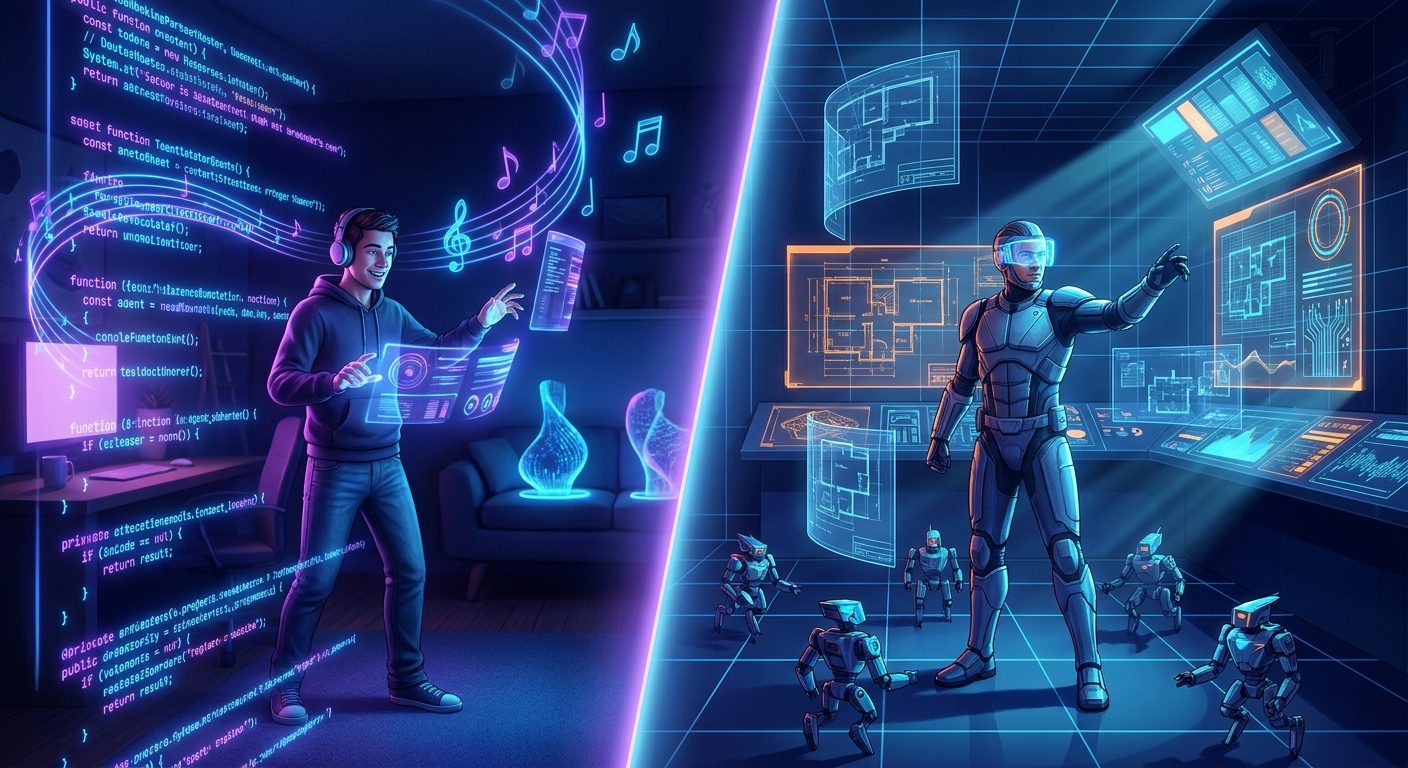
Software development has undergone a fundamental split. Between early 2025 and mid-2026, we’ve witnessed the emergence of two distinct paradigms that couldn’t be more philosophically different—yet both are reshaping how code gets written. On one side, vibe coding embraces intuition, natural language, and rapid iteration. On the other, agentic engineering demands structured orchestration, autonomous agents, and disciplined process.
Understanding this bifurcation isn’t optional for anyone building software today. It’s the difference between knowing when to prototype at the speed of thought and when to architect systems that actually survive production. Let’s break down what happened, why it matters, and how to navigate both paradigms.
The Birth of Vibe Coding: When English Became a Programming Language
In February 2025, Andrej Karpathy—co-founder of OpenAI and former Director of AI at Tesla—tweeted something that would reshape how we think about software development. He described a new way of working where you “fully give in to the vibes, embrace exponentials, and forget that the code even exists.”
The term caught fire. By March 2025, Merriam-Webster listed “vibe coding” as slang. By year’s end, Collins English Dictionary named it their Word of the Year.
What Karpathy captured was something many developers had started experiencing: the barrier between thinking about code and having code had effectively collapsed. With tools like Cursor paired with models like Claude, you could describe what you wanted in plain English, watch code materialize, run it, provide feedback in conversation, and iterate until it worked. The technical details faded into the background. What remained was the vibe—the feeling of creation without the friction of syntax.
This wasn’t entirely new. Karpathy had proposed back in 2023 that “the hottest new programming language is English.” But by 2025, the models were finally capable enough to make that practical. The “see things, say things, run things” loop became real.
The Power and the Peril
Vibe coding democratized software creation in ways that were previously impossible. Product managers could build functional prototypes. Journalists could create custom tools. Solo founders could ship MVPs overnight without writing traditional code. Kevin Roose famously called these creations “software for one”—hyper-personalized tools built for specific individual needs.
The workflow is intoxicating. You start with a high-level instruction: “Create a Python function that reads a CSV file and handles errors.” The AI generates boilerplate. You run it, spot an issue, say “Add error handling for when the file is not found,” and watch the fix appear. There’s an immediate feedback loop that produces what one commentator called “dopamine hits”—the thrill of seeing code appear faster than you can type.
But speed creates risk. A defining characteristic of pure vibe coding is that you don’t deeply understand the generated code. You’re accepting plausible-looking logic that might contain subtle security flaws, architectural inconsistencies, or what critics call “spaghetti architecture.” The codebase grows faster than human comprehension, and eventually you hit “verification paralysis”—the time saved generating code gets consumed debugging integration errors you can’t fully understand.
The criticism from established engineers was pointed: vibe coding encourages trusting an LLM’s vibes in ways inappropriate for publicly traded companies or security-sensitive applications. Studies showed AI-generated code contained 1.7x more bugs and logic errors than human-written code. The “Review Tax”—the time spent auditing vibe-coded output—consumed nearly 30% of the time saved during generation.
The Emergence of Agentic Engineering: Orchestrating Autonomy
As vibe coding gained traction, a parallel methodology emerged to address what vibe coding couldn’t: production-grade software that needed to survive months or years in enterprise environments.
By early 2026, Karpathy himself refined his thesis. “Agentic engineering” became the term for the professional maturation of AI-assisted development. Where vibe coding focused on the feeling of creation, agentic engineering focused on the engine—structured, autonomous processes where AI agents handle execution while humans focus on architectural boundaries and strategic goals.
The shift is philosophical. In vibe coding, you’re a “co-pilot” approving every line. In agentic engineering, you’re a “mission controller” or “agentic commander” who defines objectives, sets guardrails, and verifies outcomes. You’re not chatting with AI—you’re designing systems.
The Plan-Execute-Verify Framework
Professional agentic engineering follows the Plan-Execute-Verify (PEV) framework:
Plan: The human architect defines objectives, establishes acceptance criteria, and decomposes complex goals into unit-sized tasks. This requires significant domain expertise—you’re setting architectural constraints and tech stack rules that prevent the AI from producing unmaintainable code.
Execute: Specialized agents work autonomously within pre-defined constraints. Implementation agents, test generators, and security reviewers operate in parallel, iterating on code until it passes internal quality gates. The human isn’t reviewing every line—they’re setting the boundaries within which agents operate.
Verify: The final output gets evaluated against original objectives. Did it meet acceptance criteria? Does it preserve architectural integrity? Did it introduce security vulnerabilities? This is where human judgment remains essential.
This systematic approach scales in enterprise environments where predictability and accountability are paramount. While vibe coding excels at “throwaway” projects, agentic engineering handles systems that must evolve over years and comply with regulatory standards.
Multi-Agent Orchestration
A key differentiator of agentic systems is coordinating multiple specialized agents to achieve complex outcomes. This isn’t a chatbot—it’s a task system powered by reasoning models.
Several orchestration patterns have emerged:
Supervisor-Worker: A central orchestrator decomposes tasks and delegates to specialized workers. This provides centralized command and reasoning transparency.
Parallel Fan-Out: Multiple agents work simultaneously on independent sub-tasks. This dramatically accelerates large-scale refactors and batch processing.
Planner-Generator-Evaluator: An adversarial loop where a critic evaluates and rejects substandard outputs. This drives continuous quality improvement.
Consensus and Debate: Independent agents reconcile conflicting answers to minimize hallucinations. This enhances reliability in high-stakes or ambiguous decision-making.
The shift in thinking is profound: from “What prompt should I write?” to “What system should I design?”
The Infrastructure That Made This Possible: Model Context Protocol
The transition from ad-hoc prompting to systematic orchestration was made technically feasible by the rise of the Model Context Protocol (MCP). Launched in late 2024 by Anthropic and rapidly adopted by Microsoft, Google, and OpenAI, MCP solved what’s called the “M x N integration problem”—providing a universal standard for AI models to interact with external tools and data.
Before MCP, connecting an AI agent to your GitHub, Jira, database, and CRM required custom integration code for each tool and each model. The combinations exploded. Integrations were brittle, breaking with every API change.
MCP acts as the “USB-C of AI.” Build a server for a tool once, and any MCP-compatible model can plug into it. By 2026, over 2,000 MCP servers existed—integrations for HubSpot, GitHub, Jira, various databases, and more.
More importantly, MCP enabled active reasoning rather than static retrieval. Earlier RAG (Retrieval-Augmented Generation) systems merely retrieved text. MCP allows agents to perform reasoning loops—reading from one system, analyzing the output, and executing actions in another. The protocol supports sophisticated patterns like “Sampling” (servers asking the model to reason about intermediate states) and “Elicitation” (servers pausing for human input, such as OAuth flows).
This standardization mitigates what researchers call “system boundary technical debt”—the fragility where even minor API changes could cause reasoning failures. MCP enforces formal schemas and standardized interfaces, ensuring agents have reliable, auditable ways to interact with their environment.
The Tooling Landscape: Where Theory Meets Practice
The choice of development environment in 2026 depends on where you want to sit on the vibe-to-agentic spectrum.
AI-Powered IDEs: Cursor and Windsurf
Cursor has become the market leader with over 20 million users. It’s favored for polished UX and granular context control via the ”@” mention system. Its “Composer” mode allows multi-file edits, but it remains primarily an iterative, human-led tool—closer to vibe coding than full autonomy.
Windsurf (acquired by Cognition in July 2025) leans harder into agent-first workflows. Its “Cascade” agent employs automatic codebase indexing and RAG to infer context without manual file tagging. It’s superior for onboarding onto large, unfamiliar codebases. The philosophy is “agentic flow”—allowing AI to take extended actions with less frequent human interruption.
Autonomous Agents: Devin and Claude Code
Devin 2.0 is positioned as an autonomous “junior developer” designed for full-task delegation. It operates in its own cloud environment, managing infrastructure and running tests overnight. It’s the primary tool for “agentic tickets”—repetitive maintenance like library migrations or bug triage that doesn’t require constant human supervision.
Claude Code is a terminal-native CLI agent from Anthropic that’s found a niche among senior developers who prefer working closer to the metal. It’s praised for reasoning quality and handling long, messy architectural sessions where clarifying questions are more valuable than immediate code generation.
The Three Debts of AI Development
Perhaps the most critical professional discourse in 2026 centers on the long-term health of codebases generated through these paradigms. Margaret-Anne Storey, collaborating with Martin Fowler, proposed a “Triple Debt Model” to categorize hidden costs.
Technical Debt: The Visible Layer
Technical debt in the AI era is characterized by “slop code”—logic that’s functional but unmaintainable, tightly coupled, or lacking error handling. This accumulates at machine speed when vibe coding is used for production systems without subsequent productization. Analysis shows AI-generated PRs contain 1.7x more “major” issues than human-written ones, primarily flawed control flows and security vulnerabilities.
Cognitive Debt: The Erosion of Understanding
Cognitive debt represents lost shared understanding within development teams. When agents generate code, humans don’t “learn by doing.” The “theory of the system” as it exists in developers’ minds begins to erode. This creates a “silent loss of knowledge” where team members become hesitant to make changes for fear of unintended consequences. The system becomes a black box.
Intent Debt: The Missing Rationale
The newest and perhaps most critical layer is “intent debt”—the lack of externalized rationale behind architectural decisions. Historically, human-written code captured intent through naming and structure. AI-generated code is often “contextually naive,” missing the requirements, constraints, and objectives held by stakeholders. Without living artifacts like Architectural Decision Records (ADRs) or BDD specifications, neither humans nor AI agents can safely evolve the system as original intent drifts.
The Shifting Marketplace: One-Person Companies and the Experience Gap
These structural changes have profoundly impacted the software economy.
The Economics of Discernment
By 2026, the limiting factor of business was no longer labor but discernment. Solo founders like Pieter Levels, generating over $3 million annually with zero employees, proved that AI agents can handle 80-85% of execution at a fraction of traditional team costs. The unit of scale shifted from headcount to agent fleets. NVIDIA reported running 100 AI agents per human employee—7.5 million agents serving a 75,000-person staff.
The Junior-Senior Divide
The impact on the job market is asymmetric. Senior engineers who adapted to agentic engineering saw their output multiply 5-10x, commanding “exorbitant” salaries as “founder-level visionary leaders.” They bring the domain expertise, architectural judgment, and system-design thinking that agents can’t replicate.
Junior developers face a steeper learning curve. The straightforward “scaffolding” tasks they once used to build mastery are now handled instantly by agents. This created an “experience gap” where entry-level hiring bars became extremely high—requiring new developers to be proficient in orchestration and system-level thinking from day one. The on-ramp to mastery got significantly steeper.
Synthesizing the Paradigms
The distinction between vibe coding and agentic engineering is ultimately one of maturity and risk tolerance.
Vibe coding is the “creative front door”—fast, intuitive, highly accessible. It’s the paradigm of prototypes, learning sessions, and personal tools. When you need to explore an idea, validate a concept, or build something that doesn’t need to survive past next week, vibe coding is unbeatable.
Agentic engineering is the “turning point”—the discipline of designing systems, constraints, and feedback loops that let AI agents act as trusted teammates in high-stakes environments. It’s for systems that will see production, require maintenance, and must meet enterprise standards.
The future isn’t choosing one paradigm over the other. It’s harmonizing their strengths within a unified, human-centered development lifecycle. Success requires the ability to “vibe-code with passion but deploy with discipline”—ensuring unprecedented creation speed is anchored by rigorous professional engineering standards.
The age of AI-assisted development has bifurcated. Understanding both paradigms—knowing when to embrace the vibes and when to architect with discipline—is now table stakes for anyone serious about building software.