

Artificial intelligence is beginning to reshape home education, but not in the way most headlines suggest. The real change is not that families now have access to smarter software. It is that the structure of teaching at home can be strengthened, streamlined, and made more adaptive without surrendering the human core of education.
That distinction matters.
Home education has always asked a great deal of parents. In a single week, a homeschooling parent may act as curriculum planner, instructor, tutor, grader, scheduler, researcher, administrator, and compliance officer. In many households, that work is layered on top of employment, caregiving, homemaking, and the ordinary unpredictability of family life. The challenge is not merely delivering content. The challenge is sustaining a coherent educational environment over time without reducing the household to exhaustion.
This is where AI becomes interesting. Not because it can generate a worksheet in three seconds—frankly, that part is trivial—but because it can reduce structural friction in places where home education has historically been labor-intensive. Used well, AI can help families build better study systems, create more adaptive lessons, provide guided tutoring, support accessibility needs, and reduce administrative burden. Used badly, it can just as easily flatten thinking, dilute authorship, and replace formation with polished imitation.
So the central question is not whether AI belongs in home education. The central question is whether it can be used in a way that strengthens learning without quietly displacing it.
The answer is yes, but only if families are clear-eyed about what these tools are for.
The Real Shift Is From Random Prompting to Structured Learning Workflows
Most early AI use in home education was informal. Parents asked for lesson ideas, spelling lists, quiz questions, or summary paragraphs. Students used chatbots for quick explanations or writing help. That kind of use still happens, but it is not where the greatest value lies.
The more consequential shift is toward repeatable educational workflows.
Instead of asking a tool to produce isolated outputs, families are beginning to use AI as part of a structured process. A parent gathers trusted source material, defines the objective, uses the platform to generate study aids or draft lesson resources, guides the student through interaction with the material, reviews the outputs, and then archives or builds on the results. In that pattern, AI is not functioning as an oracle. It is functioning as a scaffold.
That is a much healthier role.
When AI is treated as a scaffold, it can support planning, synthesis, tutoring, translation, review, assessment prep, and adaptation. When it is treated as a substitute, it becomes a shortcut around the very intellectual labor education is supposed to cultivate.
This is the dividing line families need to keep firmly in view.
The Strongest Use of AI in Home Education Is Not Content Generation. It Is Instructional Structure.
There is a temptation to evaluate AI tools by how impressive their outputs look. That is the wrong metric.
The better question is whether a tool helps a family structure learning more effectively.
A dense chapter can become a study guide, a narrated overview, a vocabulary review, a quiz set, and a discussion outline. A messy unit plan can become an ordered sequence with clear objectives and differentiated supports. A student’s repeated confusion in one subject can be met with alternate explanations, paced review, and low-friction tutoring. A pile of informal learning experiences can be translated into coherent documentation for portfolio or compliance purposes.
None of that is glamorous. All of it is useful.
What families often need most is not more information. They need ways to turn existing information into a teachable, reviewable, and sustainable format. That is where AI is proving most effective.
Source-Grounded Tools May Prove to Be One of the Most Valuable Developments for Serious Home Educators
One of the biggest weaknesses of general AI in education is that it often operates without enough bounded context. It can produce smooth language on almost any topic, but smooth language is not the same thing as trustworthy instruction.
This is why source-grounded tools deserve special attention.
When a family uploads the material it already trusts—textbook chapters, class notes, primary sources, standards documents, readings, vocabulary lists, lab sheets, answer keys, or lecture notes—and asks the AI to work inside those boundaries, the result is a much more disciplined learning environment. Instead of generating answers from an open sea of training data, the tool is constrained to the material the parent has already chosen.
That changes the equation.
Now the parent can turn a stack of readings into:
- summaries,
- timelines,
- flashcards,
- quizzes,
- FAQs,
- guided Q&A,
- comparative outlines,
- and audio overviews.
A difficult science unit can become easier to review. A history lesson can become more interactive. An older student can engage more actively with a source set instead of just rereading it passively. A bilingual learner can receive explanation in a preferred language while still working from the assigned material.
This is where AI begins to serve home education in a more serious way. It helps families build a study layer around their existing curriculum without forcing them to surrender curricular control.
That is not a minor convenience. It gives families a more disciplined way to build study systems around the curriculum they have actually chosen.
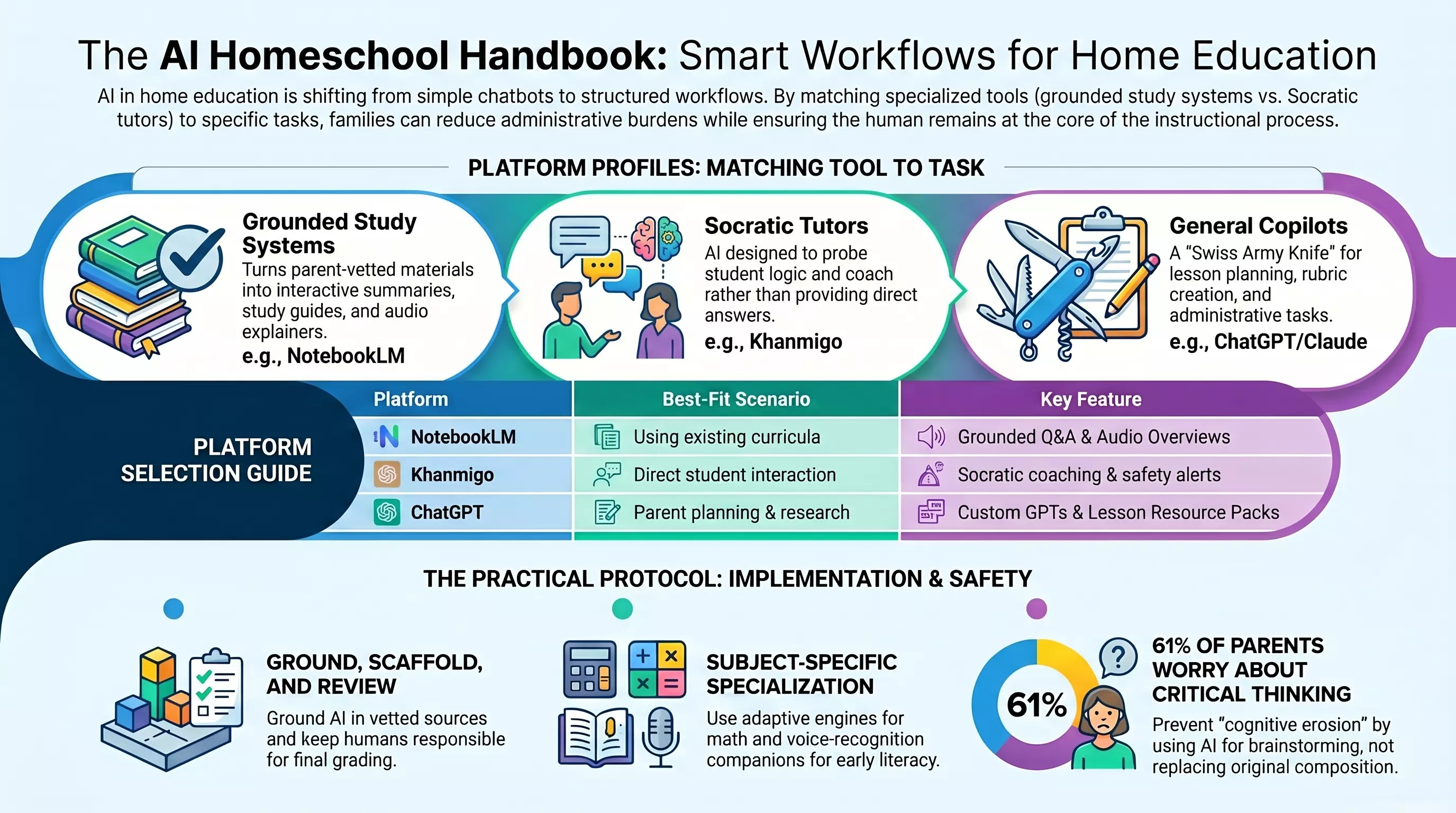
The visual distinction is useful because many families are not really choosing between “good AI” and “bad AI.” They are choosing between different instructional roles. A source-grounded notebook, a Socratic tutor, and a general-purpose copilot may all be useful in the same household, but they should not be trusted with the same kinds of work.
General AI Platforms Are Most Useful When the Parent Is Operating Them, Not When the Household Treats Them as a Free-Range Teacher
General-purpose AI tools can do many things well enough to become genuinely useful. That flexibility makes them valuable, but it also makes them easy to misuse.
For parents, these tools can be remarkably helpful. They can draft lesson packs, generate differentiated instructions, create discussion questions, reorganize raw notes into a clearer sequence, help build project prompts, rewrite material for different ages, translate communications, assist with rubrics, and support research into unfamiliar subjects. In other words, they can function as a kind of curriculum workbench.
That is where they shine.
The danger appears when a flexible planning tool starts slipping into a direct instructional role without guardrails. Because a general model is fluent, patient, and always available, it becomes easy to let it answer too much, explain too fast, or produce too polished a result. The household then mistakes convenience for growth.
A strong homeschool workflow keeps the adult in charge of orchestration. The parent sets the objective, chooses the material, shapes the prompts, reviews the output, and decides what the child should do with it. That preserves the right order of operations. AI assists. The parent governs.
Once that order is reversed, the educational value drops quickly.
Student-Facing AI Is Best When It Behaves Like a Tutor, Not an Answer Machine
Not every AI interaction in home education should look the same.
When the student is interacting directly with a tool, the design of that interaction matters enormously. A platform that simply gives answers may look efficient, but it often produces shallow dependency. A platform that asks probing questions, offers graduated hints, checks understanding, and keeps the learner active is far more valuable.
That is because learning depends on cognitive participation.
A student must still retrieve, compare, infer, articulate, and correct. If the system does all of that too early, then the child may complete the task without acquiring the underlying competence. The result is a kind of educational ventriloquism: the output looks intelligent, but the mind behind it has not done the necessary work.
This is why narrower, education-specific tools are often better for student-facing use than more powerful general models. The point is not whether the model can produce brilliant prose. The point is whether the tool is structurally aligned with tutoring rather than substitution.
For home education families, that distinction is critical. Student-facing AI works best when it slows down answer delivery, supports self-correction, and keeps the learner mentally engaged.
Anything else is a shortcut disguised as support.
Accessibility May Be One of AI’s Most Defensible Uses in the Home
A great deal of AI discussion focuses on productivity. For many families, the more important category is accessibility.
AI can make material easier to access without making it intellectually trivial. That is a meaningful distinction.
A student who struggles with dense prose may benefit from a guided audio summary before reading the chapter. A bilingual household may need instructional content translated or restated in simpler language. A learner with attention or processing challenges may benefit from shorter explanations, repeated examples, alternate formats, or more conversational reinforcement. A child who is reluctant to ask the same question five times may be more willing to work through confusion with a patient system that never gets irritated.
Used this way, AI does not replace effort. It changes the conditions under which effort becomes possible.
That may prove to be one of the most significant contributions these tools make to home education. Not because they remove difficulty, but because they help families present material in forms the learner can actually engage.
There is real educational value in turning inaccessible content into accessible content without diluting its substance.
Writing Is Where Families Need the Sharpest Boundaries
If there is one area where AI can quietly undermine education while appearing to improve it, it is writing.
This is not simply a plagiarism issue. In many cases, the more serious problem is developmental outsourcing.
Writing is one of the primary ways a student learns to think in ordered form. Drafting requires the mind to choose, sequence, refine, and defend ideas. Revising requires the student to recognize weakness, improve clarity, tighten logic, and develop voice. If AI takes over too much of that process, the student may submit cleaner work while becoming less capable.
That is a terrible trade.
Collaborative AI writing tools can be useful, but only under deliberate constraints. They can help identify repetitive phrasing, suggest transitions, expose weak argument flow, or offer alternate ways to frame a point. That can be healthy if the student has already done the core thinking. But if the system is generating the argument, composing the paragraph, or rewriting the prose into something far more mature than the student can independently produce, then the educational function of writing has been compromised.
Families need explicit rules here.
A sensible boundary might be:
- AI may help brainstorm topics or outline options.
- AI may help critique a draft the student has already written.
- AI may help identify unclear wording or weak structure.
- AI may not produce the student’s core argument or replace the first draft.
- AI may not become a silent co-author hidden behind polished output.
Home education can be especially well positioned to handle this well, since parents often have more visibility into process, drafts, and the student’s actual voice than a classroom teacher reasonably can. That kind of close visibility is difficult in a classroom and much easier in a family learning environment.
If families use that advantage wisely, they can benefit from writing support without surrendering authorship.
Assessment Support Is Valuable, but Educational Judgment Must Remain Human
One of the more practical uses of AI in home education is first-pass feedback.
A parent can use AI to help structure a rubric, evaluate a submission against specific criteria, draft feedback comments, or surface areas that need closer review. For busy households, that can save real time. It can also improve consistency, especially when the parent is assessing across multiple children, subjects, or grade levels.
But AI should remain subordinate in that process.
Educational judgment is not merely the act of scoring an output. A parent knows the child’s history, temperament, growth pattern, habitual weaknesses, strengths under pressure, and the difference between confusion, laziness, fatigue, and breakthrough. Those factors do not appear neatly in the text of an assignment. They are part of a larger relational context that the tool does not possess.
That means AI can help organize feedback, but it cannot rightly own final evaluation.
The moment a household starts using AI as the real grader while the parent merely signs off, the educational center of gravity has shifted in the wrong direction. Feedback becomes more efficient but less discerning. The result may look tidy, but it is thinner than it should be.
Home Education Administration Is an Underrated Place for AI to Add Real Value
One of the least exciting but most strategic uses of AI is administrative support.
Homeschooling generates a large amount of background work that rarely gets celebrated:
- planning weeks,
- mapping activities to standards,
- generating logs,
- organizing reading lists,
- drafting summaries,
- documenting projects,
- keeping records for co-ops or umbrella programs,
- and turning real-world learning into something reportable.
This labor is often one of the hidden reasons families feel overwhelmed. The instruction itself may be going well, but the supporting infrastructure becomes exhausting.
AI is unusually well suited to this layer of work because it excels at patterning, reformatting, summarizing, organizing, and drafting. A parent can take a pile of rough notes and turn them into a clean schedule. An informal hands-on activity can be translated into an educational summary. Project work can be turned into portfolio language. Multi-step plans can be simplified into actionable sequences.
This is not flashy, but it is important. When administrative burden drops, educational sustainability rises. A system that helps a household preserve order without constant manual reconstruction is not merely convenient. It protects continuity.
That alone may justify selective adoption for many families.
Families Should Think Carefully About Privacy, Worldview, and Data Exposure
Not every AI question is pedagogical. Some are operational and philosophical.
Privacy is the most immediate concern. Consumer AI tools make it easy to paste in large amounts of information: student writing, behavioral notes, accommodations, household patterns, personal context, even sensitive family details. Families need to be far more disciplined than most software interfaces encourage them to be.
A simple rule is wise: never provide more personal information than the task actually requires. Use generic learner labels where possible. Avoid unnecessary identifying detail. Distinguish between convenience and prudence.
Worldview is another issue that should not be treated lightly. Many home education families care deeply about the moral, philosophical, and theological assumptions shaping their children’s formation. Traditional curricula often make those assumptions more visible. General AI systems tend to obscure them behind the appearance of neutral explanation.
That does not make them unusable. It simply means they should not be treated as disembodied wisdom. Parents still need to filter, question, and govern what enters the home through these systems, especially in subjects where interpretation matters as much as raw information.
Finally, there is the issue of truthfulness. AI systems can be eloquently wrong. A fabricated citation written in polished prose is still fabricated. A smooth explanation with a false premise is still false. Families who use AI well will need to treat information literacy as a core skill, not a side concern. Students should learn early that confidence is not verification and fluency is not authority.
That is not just an AI lesson. It is a modern education lesson.
The Best Implementation Model Is Small, Disciplined, and Specific
Most families should not begin with an “AI integration strategy.” That is how people end up with elaborate systems nobody actually uses.
The better approach is to start with one friction point.
Pick one thing:
- a student struggling to review dense material,
- a parent losing too much time on lesson drafting,
- a need for more differentiated explanations,
- a desire to speed up rubric-based feedback,
- or the administrative burden of documenting learning.
Then build one bounded workflow around that problem.
Choose the tool that best fits the task. Define what it is allowed to do. Define what remains human work. Use trusted materials where possible. Review the outputs carefully. Keep what actually improves learning or sustainability. Discard what merely adds novelty.
That kind of adoption is slower, but far healthier.
The point is not to make the household feel technologically advanced. The point is to make education stronger, clearer, and more sustainable.
AI Can Support Home Education, but It Cannot Replace the Heart of It
The best way to think about AI in home education is not as a teacher, and certainly not as a parent. It is a tool for structuring support around real learning.
It can help families synthesize material, personalize delivery, support accessibility, reduce administrative burden, create better review systems, and make high-quality adaptation more feasible. Those are meaningful gains. In some households, they may be transformative.
But none of that changes the central truth: education is not the mass production of outputs. It is the formation of a person.
That means the deepest work of home education remains stubbornly human. Judgment, wisdom, character, discipline, worldview, attention, relational knowledge, and the patient shaping of mind and soul do not belong to a machine. They belong to the family.
AI can help clear away some of the debris around that work. It can reduce friction. It can extend capacity. It can make certain tasks faster, more adaptive, and more accessible.
What it cannot do is bear the responsibility of formation.
And that is exactly why it can be useful.