
Anthropic’s new Claude Tag announcement is easy to misread if you only glance at the headline. On the surface, it sounds like another “AI in Slack” launch, the kind of product update that gets reduced to bot screenshots and a pricing note. That is not what is interesting here.
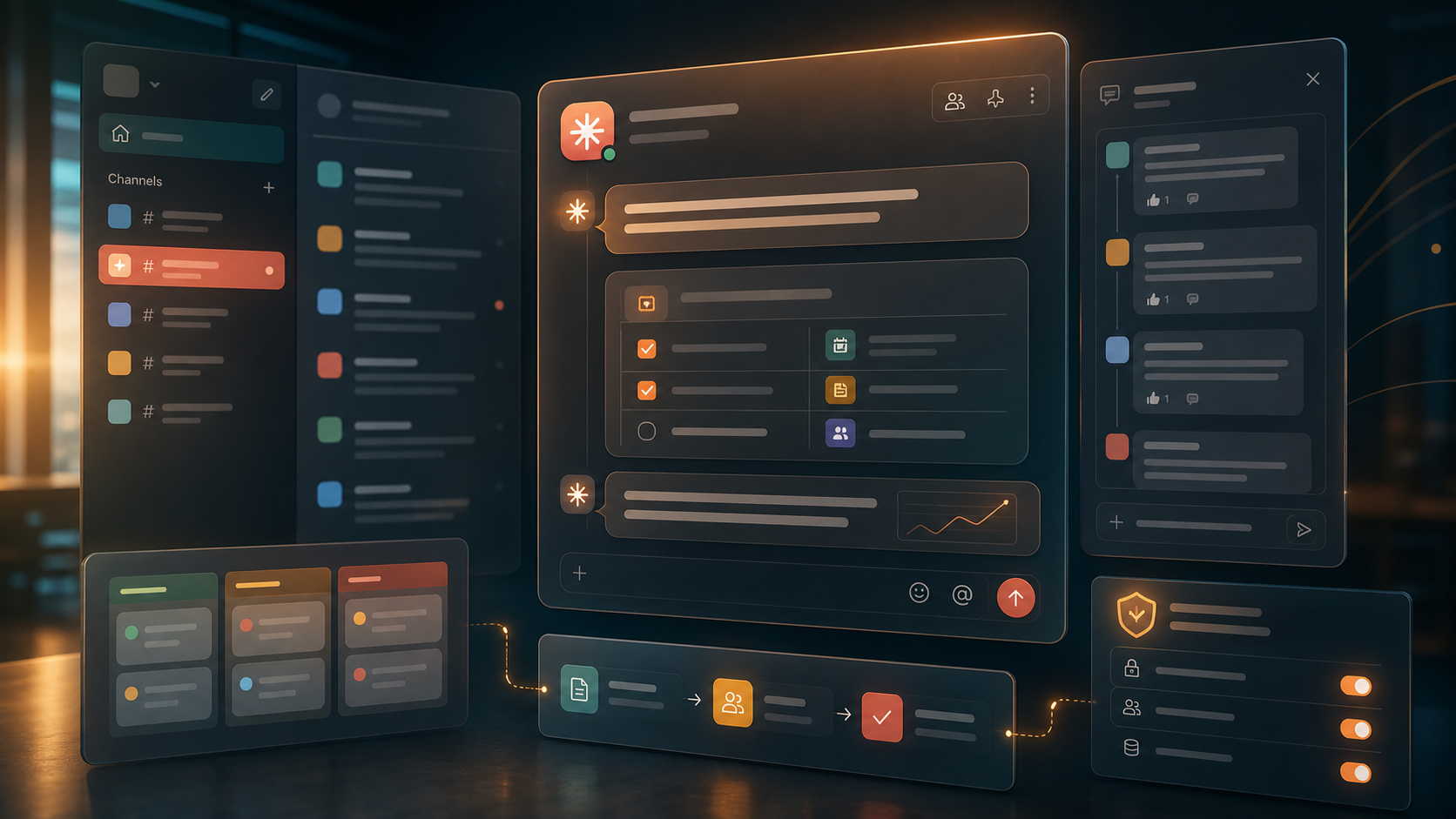
What Anthropic actually launched on June 23, 2026 is a different operating model for enterprise AI. Claude Tag places a single shared Claude identity inside a Slack channel, lets administrators decide which channels it can inhabit, which tools and data it can access, and which codebases it can touch, then lets the humans in that space tag @Claude the way they would tag a teammate. Claude works the task in stages, responds in a thread, and can keep pursuing work asynchronously over time.
That combination matters more than the Slack packaging. It shifts the center of gravity from one-person prompting toward team-level delegation. Anthropic is explicit that this is “the beginning of an evolution of Claude Code” and says tagging Claude has become one of the main ways work gets done internally. The company claims that 65% of its product team’s code is now created by its internal version of Claude Tag, while the same pattern is spreading into support, metrics analysis, and debugging. Even with the normal caution that should accompany vendor-supplied usage numbers, the product direction is unmistakable: Anthropic is not pitching Claude as a smarter chat window. It is pitching Claude as a persistent participant in team operations.
That makes Claude Tag worth paying attention to even if you never intend to use Slack as your main AI surface. The announcement reveals where Anthropic thinks collaborative agent workflows are going, and just as importantly, what technical and governance controls it believes are required before a serious organization will trust that future.
This Is Not Just a Slack Bot
Most “AI in workplace chat” products are wrappers around a familiar pattern. A user asks a question in a channel or direct message. The assistant answers. If the product is slightly more advanced, it might summarize a thread, pull a document, or create an action item. Useful, sure. Transformative, not usually.
Claude Tag is aiming at something more operational.
According to Anthropic’s announcement, each Slack channel gets one Claude that is shared by everyone in that channel. Anyone can see what it is working on. Anyone can continue the conversation from where someone else left off. That sounds simple, but it changes the interaction model in a meaningful way. A normal AI chat is private and per-user. A shared channel agent becomes part of the team’s working memory. The exchange is no longer “my prompt to my model.” It becomes “our delegated task to a visible agent operating in a shared environment.”
This is the first architectural distinction that matters. Shared visibility changes trust, handoff, and continuity.
In a normal assistant workflow, the user who started the task often becomes a bottleneck because all the context is trapped in their session. If they disappear into a meeting, leave for the day, or simply forget about the thread, the work stalls. Claude Tag is built to avoid that failure mode. The context lives in the channel, the work is visible, and another team member can pick up the interaction without reconstructing everything from scratch.
That is much closer to how real organizations operate. Work rarely belongs to one pristine thread in one person’s head. It lives in handoffs, partial decisions, scattered artifacts, and a trail of “can you check this?” messages. Anthropic is trying to place the model inside that mess rather than forcing the team to step outside it into a separate AI interface.
There is also a subtle but important difference between asking an assistant for help and assigning a teammate a task. Anthropic’s wording leans heavily toward delegation. Tag Claude with a request. Claude breaks the task into stages. Claude uses the tools it has access to. Claude responds when it is done. That sounds less like autocomplete for knowledge work and more like task execution with an audit trail.
If that framing holds up in practice, the product’s significance is not that it embeds AI into Slack. Plenty of vendors can do that. Its significance is that it treats the collaboration surface as the natural control plane for agentic work.
Shared Memory Is the Real Product
The most consequential line in the announcement may be the least flashy one: Claude “builds context by remembering relevant information from the channels it’s in.”
Anthropic expands on that idea in three ways. First, Claude follows along with the channel and accumulates context over time. Second, users therefore do not need to re-explain things from scratch every time they tag it. Third, if it is granted permission, Claude can automatically learn from other Slack channels and connected data sources, while Anthropic adds the important caveat that it does not report from private channels.
This is where the product stops being a bot and starts becoming infrastructure.
Persistent context is one of the main reasons AI systems feel impressive in demos and frustrating in real work. A fresh chat can look magical for ten minutes and then collapse under the weight of missing organizational memory. Every serious team knows this pain. The assistant gives a decent answer, but it lacks the local knowledge that actually drives the work: naming conventions, internal priorities, who owns what, which metrics matter, what “done” means here, and which edge cases always burn you if you forget them.
Claude Tag is Anthropic’s answer to that gap. Instead of forcing users to paste context into every conversation, it tries to let the model absorb the context of the working environment itself. That is a much stronger proposition than “ask Claude from Slack.” It is closer to “give Claude a bounded organizational memory and let it work from there.”
Of course, the phrase “bounded organizational memory” is doing a lot of work. Anthropic appears to understand that, because the same announcement immediately narrows the scope. Administrators define which tools and information the model can access in which channels. Anthropic tells customers to think of this as creating separate Claude identities for different uses. The announcement strongly implies that context and behavior are meant to remain shaped by those administrator-defined boundaries, even though it also says Claude can learn from other Slack channels and data sources when granted permission.
That channel-scoped identity model is not a side detail. It is the product’s trust boundary.
Without it, persistent memory in enterprise collaboration software becomes a governance nightmare. With it, Claude Tag starts to look like a serious attempt to reconcile two things that usually conflict: rich contextual performance and strict access segmentation. Anthropic is effectively saying the model can remember, but only inside an administratively defined compartment.
That is the right design instinct. Whether the implementation is strong enough is a separate question, and the announcement does not provide the technical detail needed to evaluate that. But the conceptual move is sound. Enterprise AI becomes usable when memory is not merely persistent, but scoped.
Initiative and Asynchrony Are the Bigger Leap
The announcement highlights three user-facing advantages that differentiate Claude Tag from a standard assistant workflow: it is multiplayer, it learns over time, and it can take initiative. The first two are important. The third is where the real behavioral shift begins.
Anthropic says that if “ambient” behavior is enabled, Claude can proactively keep teams updated about information it thinks they may need to know. It can flag relevant information from channels and connected tools. It can follow up on threads or tasks that have gone quiet without being resolved. It can also schedule tasks for itself and pursue a project autonomously over hours or days.
That is a different category of product from a reactive chatbot.
Reactive assistants wait for instruction. Agentic systems watch, infer, remind, and continue. The upside is obvious. Work does not stop the moment the human attention beam moves elsewhere. A task can survive interruption. A stalled issue can be resurfaced. A missing follow-up can be chased down without someone manually reopening the loop.
In practical terms, this maps to how a good operator behaves inside a team. The operator does not just answer direct questions. They notice that a thread died without a decision, that a metric moved, that a promised artifact never appeared, or that a blocker has remained unresolved for too long. Anthropic is trying to encode some version of that behavior into Claude Tag.
That does not mean the product has solved initiative cleanly. Quite the opposite. Once a model can decide when to speak, what to resurface, and which dormant threads deserve attention, signal quality becomes everything. A proactive agent that surfaces the wrong things at the wrong times stops feeling like a teammate and starts feeling like a spam generator with credentials.
The announcement does not tell us how often Claude gets this right, how administrators tune its ambient behavior, or what thresholds govern proactive follow-up. Those are not small omissions. They are the operational heart of the feature. But the fact that Anthropic is willing to ship initiative at all is significant. It suggests the company believes organizations are ready to move from “AI that answers” to “AI that monitors and advances work.”
That matters because asynchrony is one of the few AI affordances that genuinely changes throughput. If the model can do useful work while nobody is actively sitting in front of it, then the interaction pattern stops looking like search and starts looking like delegation. Anthropic says the company now spends much more of its time “delegating tasks to many Claudes in parallel.” That sentence is easy to skim past. It is also probably the sentence most worth underlining.
Parallel delegation is the management layer for agentic systems. Once teams adopt it, the human job shifts. Instead of producing every intermediate artifact directly, people increasingly define objectives, constrain access, review outputs, and intervene at the right moments. That is a different discipline from prompting, and Anthropic appears to be designing toward it explicitly.
Governance Is What Makes This Enterprise-Credible
The biggest reason many workplace AI products fail inside real organizations is not model quality. It is governance theater. They claim enterprise readiness, then crumble the moment a security lead asks basic questions about access boundaries, logging, spend controls, or who exactly authorized the model to touch the codebase.
Anthropic clearly knows those questions are unavoidable, because the “Getting started” portion of the announcement is dominated by control surfaces rather than magic tricks.
The company says administrators specify which tools and information Claude should have access to, in which channels. Everyone can begin tagging after permissions are set. Administrators can set token-spend limits both for the organization and for individual channels. They can also view a log of everything @Claude has done, along with who requested each task.
That package of controls is arguably more important than the user experience layer.
Access scoping addresses the obvious principle of least privilege problem: a model should not see everything just because it might occasionally need something. Spend caps matter because long-running autonomous workflows are not just a product question; they are a budgeting question. Audit logs matter because a shared agent acting across tools and codebases is functionally a system actor. If it modifies something, retrieves something sensitive, or burns through usage unexpectedly, an enterprise needs accountability.
None of these controls guarantee safety or correctness. A log does not undo a bad action. A spend cap does not make a poor workflow smart. Channel scoping does not magically fix prompt injection, misdelegation, or over-broad tool permissions. The announcement does not claim otherwise, and it would be absurd if it did.
What it does show is that Anthropic is treating enterprise adoption as an administrative systems problem, not merely a model access problem. That is the right frame. Organizations do not buy “intelligence” in the abstract. They buy bounded capability that can fit inside policy, budget, ownership, and review.
There is one more governance detail worth noting. Anthropic says Claude Tag replaces the existing Claude in Slack app, with administrators able to opt in within 30 days. That is not just a naming update. At minimum, it shows Anthropic wants the Slack integration to be understood as a more deeply managed, more agentic, and more organizationally aware product than the earlier app.
That replacement decision also hints at the likely migration challenge for customers. Teams that were comfortable treating “Claude in Slack” as a lightweight convenience tool may now need to think much more carefully about provisioning, connector access, spend policy, and who is allowed to create which kind of Claude identity. The product becomes more powerful, but it also becomes more of a system to govern.
Anthropic Is Turning Collaboration Software Into an Agent Surface
The announcement says Claude Tag is launching on Slack because Slack is “a natural home for collaborative work between teams and AI” and because much of Anthropic’s own day-to-day work already happens there. That explanation is practical, but it also reveals a product thesis.
Anthropic is betting that the future interface for AI work is not always a dedicated AI application. Sometimes it is the place where the team already coordinates work, asks for status, escalates blockers, and leaves a trail of decisions. In other words, the collaboration surface itself becomes the place from which agents are invoked, supervised, and remembered.
That is a much more ambitious idea than a sidebar assistant.
Once you accept that premise, several details in the announcement click into place. Shared channel identity matters because the work is collaborative. Scoped memory matters because the work accumulates across time. Tool access matters because the agent must act, not merely answer. Audit logs matter because the agent now sits inside real operations. Direct messages still exist, Anthropic notes, and those use the personal tools and connectors an individual has configured, but that feels almost like the secondary mode. The primary story is team-visible work.
This is also why Anthropic describes Claude Tag as an evolution of Claude Code rather than a separate novelty. Claude Code pushed the model closer to an execution environment. Claude Tag pushes that same logic into the team environment. The common pattern is not “chat better.” It is “embed the model where the work already lives, then give it bounded tools and enough continuity to be useful.”
For engineering organizations, that could be especially consequential. Anthropic’s own examples span code creation, root-cause analysis for difficult bugs, support tickets, and product metrics. Those are not identical tasks, but they share a workflow shape: each benefits from cross-referencing artifacts, operating asynchronously, and leaving a visible trail for teammates.
That does not mean every team should race to install a model in its primary collaboration channel and hand it a bag of connectors. That would be a fantastic way to discover new failure modes at scale. It does mean the design pattern is now clear enough to evaluate seriously. The question is no longer whether AI will be embedded into collaboration tools. That is already happening. The question is which vendors understand that collaboration, memory, and governance must be designed together rather than bolted on in sequence.
What the Announcement Actually Tells Us About the Market
Anthropic’s announcement is ultimately a product launch, not a research paper, so it does not answer every question that a security lead, an architect, or a skeptical CIO should ask. It does not explain the exact mechanics of memory retention. It does not spell out the failure modes of ambient initiative. It does not detail how organizations should evaluate tool permissions or defend connected workflows from hostile inputs. Those are real gaps, and they should stay visible.
Still, the announcement tells us several important things with surprising clarity.
First, Anthropic is competing on more than model quality alone; the announcement is clearly about team workflow design. Second, it presents persistent context as most useful when paired with administrative control. Third, it is comfortable making autonomy and initiative part of the product rather than reserving them for a lab demo. Fourth, it treats spend controls and auditability as product features, not afterthoughts. And fifth, the launch reads like a bet that at least some organizations want AI systems that behave less like search boxes and more like bounded digital operators.
That is a serious shift in product posture.
If Claude Tag works well, it could normalize a new expectation inside organizations: not that every employee chats privately with an assistant, but that teams maintain one or more specialized shared agents with scoped memory, scoped tools, and explicit administrative ownership. In that world, the organizational question becomes less “which model do we subscribe to?” and more “which work domains deserve an agent identity, what does that identity know, and who governs its boundaries?”
That is exactly the sort of question mature enterprises know how to ask. It is also the sort of question consumer AI products are usually terrible at answering. Whether or not Anthropic would frame it this way itself, the launch is positioned much closer to enterprise operating design than to consumer AI convenience.
For now, Claude Tag is available in beta for Claude Enterprise and Team customers, starts on Slack, works with Opus 4.8, and comes with an introductory launch credit for eligible organizations. Those are the product facts. The larger story is the one behind them. Anthropic is trying to turn AI from a tool an employee occasionally consults into a teammate a team can continuously direct.
That is a harder product to build than a chatbot. It is also a much more important one.