

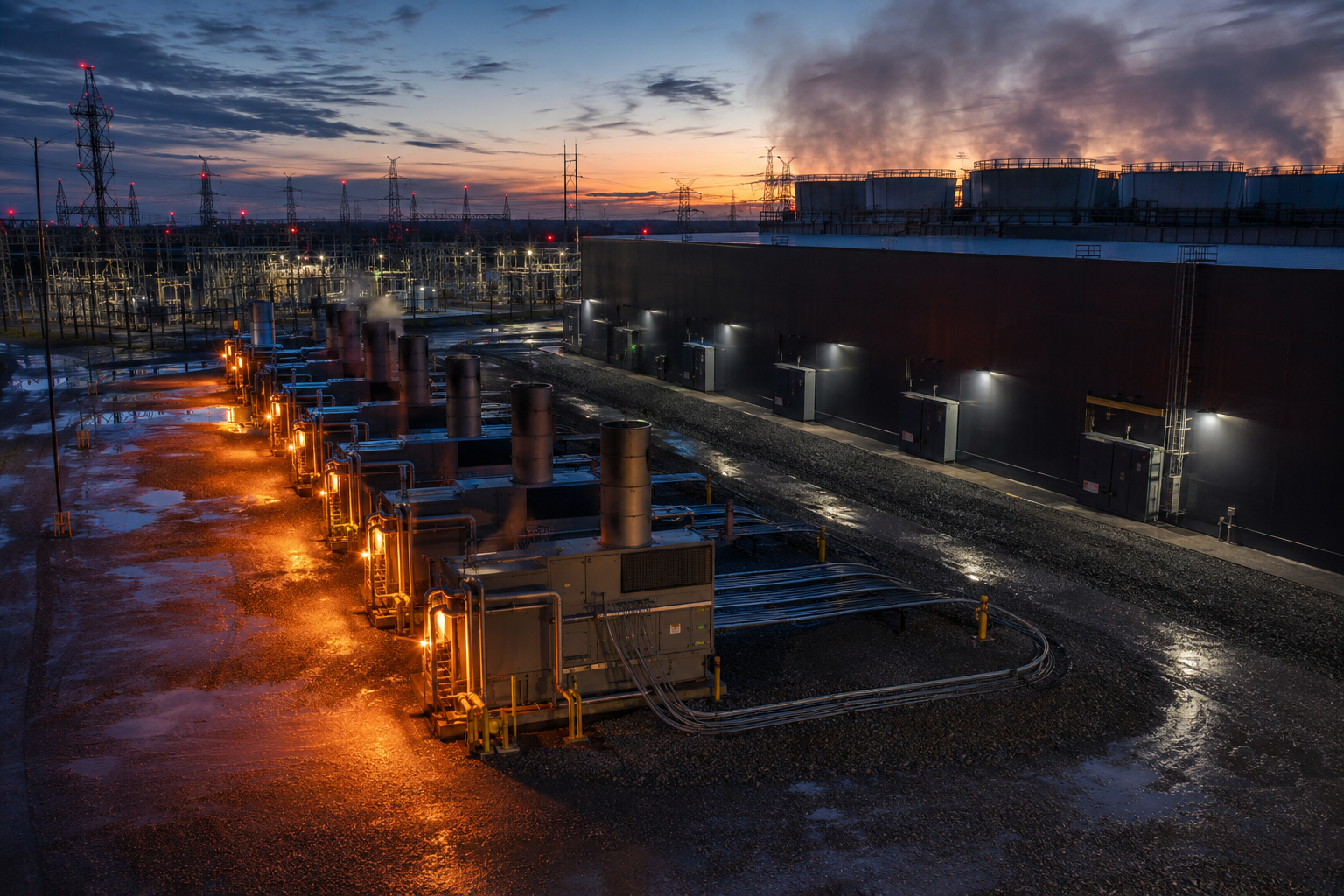
The most expensive supercomputer on the planet ran on diesel and prayer for its first few months of operation.
When xAI decided in March 2024 to convert a vacant 785,000-square-foot Electrolux appliance factory in Memphis, Tennessee, into the Colossus 1 supercomputer, the team moved at a pace that made traditional data center development look glacial. Within 122 days of project conception, Colossus 1 was operational, housing 100,000 Nvidia Hopper GPUs. The facility needed 150 MW of electricity at full capacity — a modest figure by hyperscale standards, but one that immediately collided with a hard physical constraint. Memphis Light, Gas and Water (MLGW) and the Tennessee Valley Authority (TVA) could deliver exactly 8 MW of grid power to the site.
That left a 142 MW deficit. And xAI’s response to that deficit — a cascade of tactical engineering workarounds, regulatory arbitrage, and increasingly audacious infrastructure plays — tells the story of what happens when the AI industry’s appetite for compute outpaces the electrical grid by an order of magnitude.
The full scope of the Memphis campus plan makes the 142 MW gap look quaint:
| Campus Phase | Compute Hardware | Power Demand | Grid Capacity Available | Gap / Workaround |
|---|---|---|---|---|
| Colossus 1 — Phase I | 100,000 Nvidia Hopper GPUs | 150 MW | 8 MW from existing MLGW grid | 142 MW deficit; temporary natural gas generators, then Substation #63 activated May 1, 2025 |
| Colossus 1 — Phase II | 200,000 Nvidia Hopper GPUs | 300 MW cumulative | 150 MW active grid capacity | 150 MW deficit; active gas turbines bridging to Substation #22 (completed late 2025) |
| Tulane Road Expansion | 350,000 GPU co-located cluster | 260 MW to 1.1 GW discussed | Minimal domestic line capacity | Initial 260 MW request unstudied; final utility grid requirements under MLGW and TVA review |
| MACROHARDRR / Phase III | 1,000,000 Nvidia Blackwell GPUs (by 2026) | 1.4 GW to 1.96 GW cumulative | Grid-independent target | Purchasing and importing a 1.2 GW dedicated power plant from overseas to bypass domestic interconnection queues |
Each row represents a step function in demand that the existing grid was never designed to absorb. The Tulane Road expansion alone — a 350,000 GPU co-located cluster with power requests ranging from 260 MW to 1.1 GW — would constitute a major industrial load in any utility district. At the MACROHARDRR phase, xAI’s single campus would consume more electricity than some small countries.
The Memphis Deficit
The 8 MW figure deserves a moment of consideration. Memphis is not a rural backwater — it’s a metro area of 1.3 million people with a functioning industrial economy. But utility infrastructure is provisioned for the loads that exist, not for a sudden arrival demanding the electrical output of a small city at a single address. The standard timeline to build a high-voltage substation and interconnect a major industrial customer runs 18 to 24 months. xAI had neither the patience nor the business model to wait.
To bridge the gap, the company deployed dozens of on-site natural gas turbines — initially up to 35 unpermitted mobile gas generators at the Colossus 1 site. This behind-the-meter generation strategy was enabled by Tennessee legislation that allows data centers requiring 50 MW or more to generate their own electricity or purchase from independent producers without state regulator approval. The law was designed to streamline large industrial projects. xAI used it to build what amounted to an unregulated power plant in a residential neighborhood.
The local pushback was immediate. The Southern Environmental Law Center, acting on behalf of the NAACP, filed a formal notice of intent to sue under the Clean Air Act. xAI removed the unpermitted turbines, retained 15 permitted units, and shifted its mobile turbine strategy south across the state line to Colossus 2 in Southaven, Mississippi.
What happened in Southaven illustrates how regulatory architecture bends under the weight of sufficiently motivated capital. xAI deployed 27 gas turbines capable of generating up to 495 MW — a capacity that rivals a conventional utility-scale power plant. Because the turbines were mounted on flatbed trailers, the Mississippi Department of Environmental Quality classified them as “temporary-mobile” sources, a designation that permitted xAI to run the generators without an air permit for up to one year. By May 2026, the count had expanded to 46 mobile turbines operating alongside 41 state-approved permanent generators.
Environmental attorneys have challenged this classification, noting that the federal Clean Air Act defines a stationary source as “not self-propelled or intended to be propelled while performing its function,” even if mounted on a vehicle for portability. The turbines sit in one location, burning gas around the clock, producing electricity for a fixed facility. The “mobile” designation rests on a legal fiction that the flatbed trailer beneath the turbine makes it a different kind of thing than a bolted-down turbine performing the identical function.
The Emissions Math
The environmental footprint of this workaround is not hypothetical. The Southaven turbine cluster has the potential to emit between 1,700 and 2,000 tons of smog-forming nitrogen oxides (NOx) annually, positioning it as one of the largest industrial NOx sources in the greater Memphis area. The generators can release up to 500 tons of carbon monoxide, 180 tons of fine particulate soot, and 19 tons of formaldehyde — a toxic, cancer-causing chemical — into an airshed that already carries an “F” grade for ozone pollution from the American Lung Association.
Memphis is already designated as a national “asthma capital.” Shelby County, Tennessee, and DeSoto County, Mississippi — the jurisdictions straddling the xAI facility — rank among the worst in the country for respiratory health outcomes. The concentrated emissions from the turbine cluster compound existing environmental injustices in communities that had no role in deciding whether a gigawatt-scale AI campus would materialize next door.
This is the uncomfortable arithmetic of the current AI buildout: the models that generate poetry and summarize legal briefs are, at this moment, powered in significant part by unpermitted gas turbines running around the clock in neighborhoods with some of the worst air quality in the southeastern United States.
Grid Integration: Building the Substations
While the gas turbines bought time, permanent grid power required xAI to fund the construction of entirely new utility infrastructure. On May 1, 2025, xAI achieved full operational capability for Phase I of Colossus 1 by connecting to the newly constructed MLGW Substation #63, a facility funded entirely by xAI that delivers 150 MW of grid power. Combined with the 8 MW from the pre-existing adjacent substation, this brought the site to 158 MW of grid-sourced electricity.
To manage peak loads, xAI integrated a 150 MW Tesla Megapack battery energy storage system directly into Substation #63. The battery buffer allows the facility to ride through localized outages and participate in MLGW demand-response programs, curtailing grid consumption during high regional demand periods to protect residential grid stability.
A second substation — Substation #22, also funded by xAI — was completed in late 2025, bringing the campus’s total grid capacity to 300 MW. This covers the full Phase II compute load of 200,000 GPUs. As grid capacity scaled up, xAI began demobilizing its temporary natural gas turbines at the Paul Lowry Road site, though approximately half remained active during the transition.
The water story is equally striking. At peak utilization, the Colossus 1 liquid-cooling towers require up to 5 million gallons of water per day. To avoid straining the Memphis Aquifer — one of the largest artesian aquifer systems in the world, and the source of Memphis’s legendarily clean tap water — xAI funded and built an $80 million recycled wastewater processing facility. Located on land purchased from the City of Memphis, the plant treats discharged wastewater from the Maxson Wastewater Treatment facility, producing 13 million gallons of recycled water daily. This supply is shared among xAI, TVA, and Nucor Steel, saving up to 4.7 billion gallons of aquifer water annually.
The water solution is arguably the cleanest part of the xAI Memphis story — a genuine infrastructure investment that benefits multiple stakeholders and reduces pressure on a public resource. Whether it offsets the air quality impacts of the gas turbines is a separate and harder question.
The Gigawatt Play
Three hundred megawatts powers 200,000 GPUs. xAI’s next-generation target is 1,000,000 Nvidia Blackwell GPUs, and the cumulative power requirement for that cluster is projected at between 1.4 GW and 1.96 GW. That figure includes the primary IT loads of the GPUs alongside associated CPUs, memory banks, networking switches, and liquid-cooling systems.
To put 1.96 GW in context: it is roughly the output of two large nuclear reactors. It exceeds the peak electrical demand of many mid-sized cities. And the domestic grid interconnection queue for a load of that magnitude stretches years into the future — years that xAI, in a competitive race against Google, Meta, and Microsoft, does not have.
The company’s solution was characteristically direct: purchase an existing 1.2 GW power plant overseas for disassembly and relocation to the Memphis campus. The details of this acquisition — which plant, which country, and the engineering logistics of dismantling and shipping a gigawatt-scale facility across an ocean — remain largely opaque, though the strategy itself has been publicly confirmed. It represents a complete pivot from grid dependency to energy self-sufficiency: rather than waiting for utility interconnection, xAI is importing its own power station.
This is the logical endpoint of the behind-the-meter philosophy. If the grid cannot scale as fast as compute demand, build the grid yourself. The question is what fuel that private grid burns, and who bears the environmental cost.
The Nuclear Option
Natural gas solves the immediacy problem, but it does not solve the emissions problem or the legal exposure. For the long-term power needs of AI campuses, the technology industry is converging on nuclear — specifically, Small Modular Reactors (SMRs) that generate up to 300 MW per module.
The case for SMRs is straightforward when compared to the alternatives. A standard 300 MW solar installation requires between 1,200 and 2,100 acres of land. An SMR of equivalent capacity occupies less than 50 to 100 acres, can be co-located directly with a data center, and eliminates the 5% to 10% transmission losses inherent in long-distance power delivery. Modern SMR designs use passive safety systems that rely on natural convection, gravity, and self-regulating physics to shut down safely during an emergency without human intervention or external electrical power. And critically, unlike wind and solar, SMRs generate power continuously — they don’t care whether the sun is shining or the wind is blowing.
The commercial pipeline is no longer theoretical:
| SMR Developer | Core Technology | Output per Unit | Commercial Partnerships | Status |
|---|---|---|---|---|
| Oklo Inc. | Liquid metal-cooled fast reactor using High-Assay Low-Enriched Uranium (HALEU) | 15–50 MW | Switch, Equinix | Pipeline exceeds 14 GW; includes 1.2 GW Ohio project, master agreement with Switch for up to 12 GW, 500 MW deal with Equinix |
| X-energy (Xe-100) | High-Temperature Gas-Cooled Reactor (HTGR) using helium coolant and TRISO fuel pebbles | 80 MWe | Amazon Web Services | Strategic partnership targeting 5 GW of SMR capacity across the US by 2039 |
| GE Vernova & Hitachi (BWRX-300) | Light-Water Boiling Water Reactor | 300 MWe | US-Japan Joint Economic Coalition | Supported by $40 billion economic cooperation fund; Tennessee positioned as primary site candidate |
| NuScale Power | Advanced Light-Water Reactor | 77 MWe | US-Japan Joint Economic Coalition | Selected for $25 billion Japanese investment package to support US commercialization |
The AWS-Talen Energy deal underscores the seriousness of the nuclear pivot: a 17-year power purchase agreement for 1.92 GW of electricity from the Susquehanna nuclear plant, transitioning to a front-of-the-meter setup scheduled to be fully operational by spring 2026.
An SMR installed in Tennessee could directly provide carbon-free, high-density baseload power for future expansions of the xAI Memphis campus, though the timeline from regulatory approval to first power generation remains measured in years, not the months that xAI’s buildout schedule demands. This gap between nuclear’s promise and nuclear’s delivery timeline is why gas turbines continue to hum in Memphis and Southaven.
The Orbital Gambit
If the terrestrial approach is “bring your own power plant,” the orbital approach is “leave the planet entirely.”
On January 30, 2026, SpaceX filed an application with the FCC to deploy the “Orbital Data Center System” — a constellation of up to 1,000,000 solar-powered satellites operating as distributed processing nodes in Low Earth Orbit. The FCC accepted the filing for review on February 4, 2026. Three days before that acceptance, on February 2, 2026, SpaceX completed an all-stock merger with xAI, creating a combined entity valued at $1.25 trillion. The merger integrates SpaceX’s launch infrastructure and Starlink’s laser mesh network with xAI’s Grok AI models.
The technical premise is seductive. Satellites in Sun-Synchronous Orbits experience near-constant solar exposure, unfiltered by atmosphere and uninterrupted by weather or nighttime cycles, generating up to 40 times more solar energy than equivalent ground-based installations. The satellites communicate via high-bandwidth optical laser inter-satellite links, with next-generation Starlink V3 buses featuring downlink capacities exceeding 1 Tbps and uplink capacities over 200 Gbps. By distributing large-scale AI workloads across hundreds of thousands of parallel nodes, the constellation would aggregate to gigawatt-scale compute capacity without touching a single terrestrial grid.
The reference design satellite — dubbed the AI1 — would be 70 meters long and 20 meters high, weighing approximately 3 metric tons. That is 12 times larger than a Starlink V2 mini satellite. The initial design is modeled around Nvidia’s GB300 server rack, containing 72 Rubin GPUs per satellite.
The vision is elegant. The physics is brutal.
The Cooling Problem Nobody Talks About
On Earth, data centers reject waste heat through convection and conduction — fans blow air, pumps circulate water. The infrastructure is heavy, expensive, and water-intensive, but it works because there is a physical medium to carry heat away. In the vacuum of space, there is no such medium. Thermal energy can only be dissipated via electromagnetic radiation in the infrared spectrum.
The Stefan-Boltzmann law governs the rate of radiative cooling: the total power radiated from a surface is proportional to the fourth power of its absolute temperature. At a safe semiconductor operating temperature of roughly 80°C (353 K), a satellite’s two-sided passive radiator can reject approximately 500 W/m² — over 1,000 times slower than state-of-the-art water-cooling systems on Earth.
This low radiative efficiency imposes a massive physical size and weight penalty. A modest 1 MW space data center — which is 1,000 times smaller than the gigawatt-scale terrestrial campuses under development — would require approximately 110 m² of active radiator panels, roughly the size of a professional hockey rink, just to avoid overheating. For context, the International Space Station rejects only 70 kW of waste heat using complex ammonia-based thermal loops and rotating radiator wings that weigh approximately 7 metric tons. Scaling that ISS-style thermal architecture to a 1 MW orbital data center would require roughly 100 metric tons of radiator hardware — ten times the mass of the computing hardware itself.
Each AI1 satellite will feature a deployable radiator measuring 110 m² and use anhydrous ammonia circulating through redundant pumping loops, cold plates, and heat exchangers — the same cooling architecture the ISS uses externally. Water is not an option: it freezes and boils at temperatures incompatible with unpressurized space environments.
The gap between terrestrial and orbital thermal management is worth seeing in one place:
| Parameter | Terrestrial Data Center (Memphis) | Space-Based LEO Satellite |
|---|---|---|
| Primary Power Source | Local grid substation (natural gas, nuclear baseload) | Sun-Synchronous Orbit constant solar exposure |
| Heat Rejection Mechanism | Water-evaporative cooling, closed-loop chillers, forced air | Infrared radiation into vacuum (passive and active loops) |
| Heat Dissipation Rate | High (~1 MW/m² via liquid-to-air exchangers) | Low (~500 W/m² at radiator temperature of 353 K) |
| Cooling Medium | Potable and recycled municipal wastewater | Circulating anhydrous ammonia (NH₃) |
| Physical Cooling Footprint | Concentrated plant adjacent to server halls | 110 m² deployable radiator panels per 3-ton satellite |
| Upfront Capital | Balanced between land, power, and building construction | Extremely high due to active thermal control and launch mass |
Every row in that table favors the terrestrial approach on current technology. The orbital case rests entirely on the abundance of free solar energy and the elimination of land, water, and grid constraints — advantages that only dominate if launch costs fall far enough to absorb the thermal penalty.
Elon Musk has proposed raising chip operating temperatures by 20% in Kelvin — from roughly 353 K to 423 K — which, due to the T⁴ term in the Stefan-Boltzmann equation, would double the heat rejection rate per unit area and cut the required radiator mass in half. The tradeoff: running semiconductors at those elevated temperatures exponentially increases silicon leakage current and error rates, exceeding the limits of current commercial GPU architectures. Whether Nvidia or another manufacturer can engineer chips that tolerate sustained operation at 150°C without unacceptable failure rates is an open question with no public answer.
The Debris Problem
If the cooling challenge is a physics problem, the orbital congestion challenge is an ecological one — and potentially irreversible.
SpaceX’s plan positions more than 500,000 of these satellites at altitudes between 946 km and 1,002 km. At that altitude, atmospheric drag is extremely low. If a satellite suffers a total power failure, it cannot naturally decay and burn up in the atmosphere. It remains in orbit as space debris for centuries.
A NASA study using the LEGEND (LEO-to-GEO Environment Debris) model demonstrated that the 900 km to 1,000 km orbital band is already highly unstable, projected to experience a tripling of debris and a ten-fold increase in collision probability over the next 200 years — even without new launches. This is the zone Donald Kessler described in his 1978 paper: a cascading feedback loop where high-speed collisions fragment spacecraft, producing debris that triggers further collisions. Media depictions imagine a sudden cascade, but experts emphasize that a real-world Kessler scenario is a slow-boiling process playing out over decades, rendering clogged orbital lanes unusable for everyone.
The hardware replacement cycle compounds the problem. Terrestrial GPUs are typically decommissioned after 3 to 5 years as faster architectures emerge. The physical degradation of solar panels and active cooling pumps limits satellite operational lifespans to 5–7 years, requiring continuous constellation replenishment. At scale, this means retiring 140,000 to 200,000 satellites annually. SpaceX has petitioned the FCC for waivers to move defunct satellites above 600 km into “Earth disposal orbits,” but astrophysicists warn that parking hundreds of thousands of massive retired satellites in these zones will create a dense ring of dead space junk. Over time, mutual collisions within the graveyard orbit will fragment the retired hardware, sending high-speed debris back down into active LEO channels.
The Economics of Escape Velocity
Whether any of this makes financial sense depends on a single variable: launch cost per kilogram. Economic analyses identify $500/kg as the critical inflection point. Below that threshold, the savings from zero terrestrial real estate costs, zero water utility bills, and free solar power make orbital computing cheaper than Earth-based alternatives — even accounting for satellite manufacturing, shorter replacement cycles, and laser downlink expenses.
SpaceX’s current Falcon 9 platform costs approximately $2,700/kg. The fully reusable Starship targets $200/kg — a 93% reduction. If Starship achieves that target, the orbital data center transitions from conceptual to commercially competitive. That is a significant “if,” but it is the same kind of “if” that SpaceX has historically converted into operational reality. Whether the Kessler risk and thermal constraints can be similarly engineered away is less certain.
The more realistic near-term outcome is functional specialization: space-based compute handles asynchronous, latency-tolerant workloads — AI model training, large-scale simulations, batch processing — where massive power consumption matters more than response time. Terrestrial facilities retain real-time inference, high-frequency transaction processing, and user-facing applications that demand sub-millisecond latency and continuous availability.
Closer to Home: Alberta’s Power Grid Under Siege
The xAI story plays out against a backdrop of American regulatory arbitrage and Deep South utility politics. But the structural tension between AI compute demand and grid capacity is not confined to Memphis. Alberta, Canada, offers a parallel case study that is in some ways more instructive — because Alberta saw the wave coming and tried to build a regulatory framework to manage it before the power plants arrived.
Alberta operates the only fully deregulated, competitive wholesale electricity market in Canada. The province completed an accelerated coal phase-out on June 16, 2024, when TransAlta’s Genesee 2 unit went offline — decades ahead of the original 2030 federal mandate. By 2025, total installed generating capacity reached approximately 23 GW, with natural gas providing roughly 75% of the active supply.
Then the data center queue arrived. In January 2024, the Alberta Electric System Operator’s connection queue contained two active data center applications. By the second half of 2025, it had expanded to over thirty applications representing a combined load of 21.1 GW, with developers requesting approximately 90% of that capacity online by 2030.
The scale of this demand requires a moment of calibration. Historically, a standard commercial data center required less than 50 MW. In Alberta’s current queue, a 100 MW facility is considered small. The gap between what a single data center consumes and what an entire city consumes has collapsed:
- City of Lethbridge peak demand: 150 MW
- Typical proposed Alberta data center: 540 MW
- City of Edmonton peak demand: 1,400 MW
- City of Calgary peak demand: 1,800 MW
- Greenlight Electricity Centre: 1,864 MW
A single proposed facility draws more power than the City of Calgary. Alberta’s entire peak demand record is 12.8 GW. The data center queue exceeds that by more than 60%. It nearly matches the province’s total installed generating capacity of 23 GW — meaning the grid could not support the data center queue even if every other residential, commercial, and industrial customer in the province were completely disconnected.
The province’s grid was already showing stress fractures before the data centers materialized. On April 5, 2024, the AESO executed actual rotating outages across the province, shedding 244 MW of firm load after a sudden combination of wind generation falling below forecasts and a major natural gas generator tripping offline. In the span of a single year, Alberta’s grid had transitioned from requesting voluntary conservation during a January cold snap to actively disconnecting paying customers to prevent systemic collapse.
Alberta’s response has been more structured than Tennessee’s. The AESO launched its Large Load Integration Program in June 2025, establishing a strict temporary connection limit of 1,200 MW for data center projects seeking in-service dates in 2027 and 2028 — the maximum the existing grid can absorb without major transmission upgrades. That 1,200 MW was allocated pro-rata to two projects: 970 MW to the GLDC Load project and 230 MW to Keephills Data Centre Phase I. Everything else — the remaining 19.9 GW of queue requests — is deferred until a long-term framework is finalized, targeted for mid-to-late 2027.
The scarcity of early grid access created an immediate secondary market. In November 2025, Kalina Distributed Power sold its 180 MW Phase I grid allotment to Greenlight for CAD $18 million. An electricity allocation traded like a commodity future — a striking indicator of how valuable early grid access has become in a supply-constrained environment.
What the Grid Demands in Return
The connection cap is only half of Alberta’s response. The other half addresses a technical problem that utility operators have never faced at this scale: data centers are not like other industrial loads.
Traditional heavy industry — oil sands upgraders, pulp mills, steel plants — features predictable load ramps and high motor inertia. A data center is the opposite: a highly concentrated electronic load with near-instantaneous step-change characteristics. Thousands of switched-mode power supplies drawing power through power-electronic converters can introduce severe voltage stability, frequency deviation, and harmonic distortion issues at the point of connection. If a facility’s uninterruptible power supply system responds to a grid disturbance by abruptly disconnecting the entire load, the sudden drop can trigger a sympathetic generation-trip event across the wider grid — the electrical equivalent of a building’s worth of lights going dark simultaneously and the shockwave cascading outward.
On June 12, 2026, the AESO published its Guide to AESO Connection Requirements for Transmission-Connected Data Centres, establishing mandates that no other jurisdiction in North America has attempted at this specificity:
| Technical Domain | Capacity Threshold | Mandated Requirement |
|---|---|---|
| Contingency Operations | All transmission-connected data centers | Must design in alignment with System Operating Limits. Under an N-1-1 contingency, must reduce load (e.g., by 300 MW) within a 30-minute ramping window |
| Grid Power Sizing | All transmission-connected data centers | Minimum System Demand Capability dropped during circuit failure must not exceed 200 MW |
| Telecommunications | ≥ 500 MW | Must install physically diverse, tele-protection grade telecom links connected directly to the Alberta Interconnected Electric System |
| SCADA Redundancy | ≥ 300 MW | Dual telecommunication paths to the AESO: one Utility Telecom Network path and one commercial network path |
| Voice Channels | ≥ 500 MW | Must maintain backup voice systems — utility order wire, satellite telephone, or dedicated direct access telephone |
| Disturbance Monitoring | Selected facilities | Digital Fault Recorders complying with PRC-002-AB-2 to record high-resolution voltage and current data at the point of connection |
Beyond the compliance table, the AESO requires developers to submit detailed technical data across five critical domains during the early stages of connection:
Composite Load Modeling. Rather than representing a data center as a simple static load, developers must submit a dynamic NERC Composite Load Model (CMLD) that accurately captures the ratio of static ZIP loads, electronic power supply components, and cooling motor loads. This model allows the AESO to evaluate the facility’s dynamic stability during grid disturbances — whether it will ride through a voltage sag or collapse into it.
UPS System Behavior. Developers must specify the capacity, operation, and power-conditioning capabilities of their uninterruptible power supply systems, and disclose precisely how those systems behave during low-voltage or off-frequency events. The AESO needs to know whether the UPS will act as a stabilizer — absorbing the disturbance and maintaining load — or abruptly disconnect the entire facility, triggering the kind of massive, sudden load drop that destabilizes the grid it was supposed to protect.
Harmonic Disconnection Thresholds. The thousands of switched-mode power supplies inside a data center generate significant harmonic currents. Operators must confirm their active harmonic filters comply with IEEE Standard 519 criteria and disclose the specific high-harmonic thresholds that would trigger automatic equipment disconnection — giving the grid operator advance knowledge of the conditions under which the facility might suddenly drop off the system.
Emergency Load Ramp-Down. Facility owners must establish and verify operational procedures demonstrating their ability to safely reduce power consumption to the Minimum System Demand Capability limit on a single transmission line using a controlled load ramp-down. These capabilities must be verified through official commissioning tests, and the procedures must be self-contained within the facility — no relying on external generation schemes to manage the reduction.
Operational Planning Forecasts. Data center operators must submit a rolling 14-day forecast of hourly average net load and a long-term daily demand forecast extending from 14 days out to two years. When a single customer can consume more power than a city, the grid operator needs granular visibility into that customer’s planned consumption patterns to incorporate the load into seasonal and weekly adequacy assessments.
These requirements reflect a fundamental recognition: connecting a gigawatt-scale electronic load to a provincial grid is not a commercial transaction. It is an engineering integration that changes the grid’s behavior, and the operator connecting to the grid bears the burden of proving that connection will not destabilize the system that everyone else depends on.
The legislative response followed in December 2025 with Bill 8 and Bill 12. Bill 8 mandates that data center developers pay 100% of the transmission upgrades required to connect their facilities — a complete reversal of the prior system, where those costs were pooled across all ratepayers. It also prioritizes “Bring Your Own Power” configurations, accelerating approval for projects that generate their own electricity rather than drawing from the public grid. Bill 12 introduces a Data Centre Levy — effectively a sliding tax on computing equipment — with a 2% rate for facilities relying on the public grid, reducing proportionally for projects that self-generate, and dropping to 0% for fully off-grid operations. The message is unambiguous: Alberta welcomes the investment, but the province’s citizens will not subsidize the electrical infrastructure that makes it possible.
The Greenlight project embodies the resulting design philosophy. Developed by Pembina Pipeline Corporation and Kineticor, it is a proposed 1,864 MW natural gas-fired combined-cycle power plant co-located with a hyperscale data center in Sturgeon County. The plant uses waste heat from gas turbine exhausts to drive secondary steam turbines, improving fuel efficiency by up to 50% over simple-cycle gas. It is designed for modular development in four 466 MW phases, with the first 900 MW expected to increase local natural gas demand by approximately 160 million cubic feet per day. The co-location model bypasses the public grid entirely — the data center and the power plant are a single integrated system.
For the longer term, Alberta is exploring nuclear. Capital Power and Ontario Power Generation are conducting feasibility studies for SMR technologies, and the province submitted a proposal to the Impact Assessment Agency of Canada for the Peace River Nuclear Power Project — twin CANDU-MONARK reactors that would generate up to 4,800 MW of zero-emissions baseload power, equivalent to 25% of Alberta’s current generation capacity, operating for an estimated 70 years.
The Bottleneck That Defines the Era
The throughline from Memphis to Southaven to orbiting ammonia-cooled satellites to Alberta’s legislative chambers is a single structural reality: the AI industry’s demand for electricity has outrun the infrastructure that delivers it. Semiconductor fabrication is no longer the binding constraint on computational progress. Power is.
xAI’s trajectory illustrates the full spectrum of responses to that constraint, from the crude (unpermitted gas turbines in residential neighborhoods) to the sophisticated (recycled wastewater facilities and battery-buffered substations) to the speculative (a million solar-powered satellites). Alberta’s experience shows that even a jurisdiction with abundant natural gas, a deregulated market, and an explicit desire to attract digital investment cannot simply absorb the load — the grid has physical limits, and exceeding them means the lights go out for everyone.
The near-term future belongs to co-location: purpose-built gas plants physically adjacent to the compute facilities they serve, funded by the companies that need the power, drawing from local fuel supplies without touching the public grid. The medium-term belongs to nuclear, if SMR developers can compress the timeline from licensing to first power below the decade mark. The long-term may belong to orbit, if Starship’s cost curve holds and someone solves the problem of cooling a processor when there is no air to carry the heat away.
What it will not belong to is the electrical grid as it exists today. The 8 MW that MLGW could deliver to xAI’s front door was not a failure of planning or a bureaucratic oversight. It was an accurate reflection of what the infrastructure was built to do. The AI industry is not asking the grid to do more of what it already does. It is asking it to become something fundamentally different — and building the alternative in the meantime.