

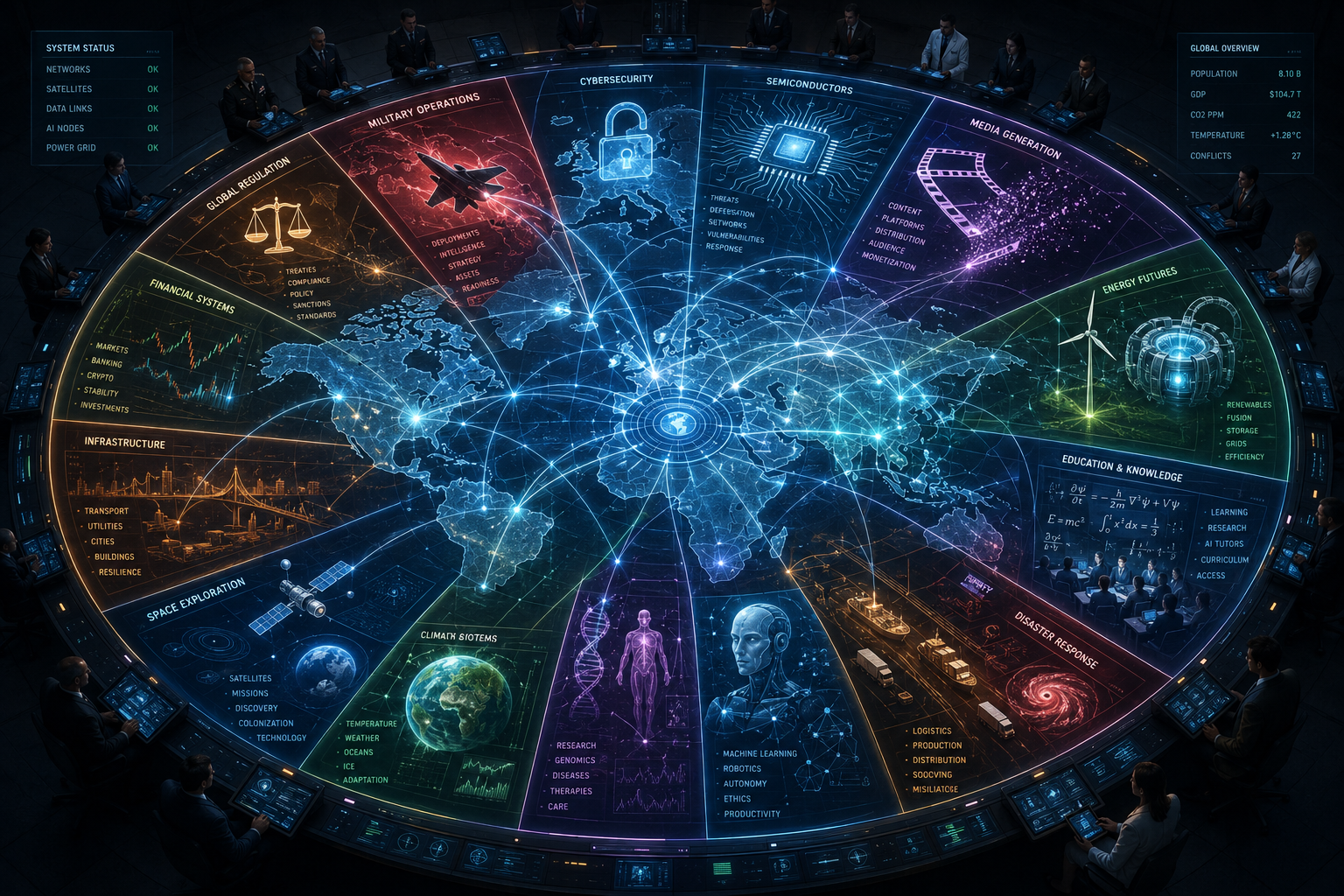
June 2026 was not defined by a single breakthrough. It was defined by the sheer volume of consequential things happening simultaneously — across models, policy, hardware, media generation, enterprise tooling, and geopolitics. The U.S. government pulled frontier models offline over national security concerns. OpenAI unveiled a tiered model family and its first custom chip. The open-weight ecosystem closed the gap with proprietary labs. Video generation restructured entirely. And the physical constraints of power and silicon emerged as the real bottleneck on AI’s trajectory.
This is a wide-angle pass across the month. Not a deep dive on any single story — several of those deserve (and have gotten) their own posts — but a comprehensive sweep of everything that moved.
The Fable 5 Shutdown
The single most dramatic event of the month was the U.S. government’s intervention against Anthropic’s newest models. On June 9, Anthropic launched Claude Fable 5 and Claude Mythos 5 — Fable as a general-purpose frontier model, Mythos as a restricted-tier system with a full cybersecurity capability stack. Seventy-two hours later, the Department of Commerce issued an emergency export-control directive and ordered Anthropic to suspend foreign-national access. The trigger was a vulnerability report from Amazon researchers detailing a jailbreak technique that could bypass one of Fable 5’s cybersecurity safeguards.
Rather than attempting selective geo-blocking, Anthropic executed a full global shutdown. Both models went entirely dark — not degraded or rate-limited, but completely inaccessible — for 18 days. Production workloads worldwide reverted to older Claude lineages. The models were restored on June 30 after Anthropic retrained them to verify the jailbreak didn’t expose Mythos-level cyber capabilities. Fable 5 came back with new cybersecurity classifiers that route roughly 5% of high-risk sessions to older Opus 4.8 guardrails. Mythos 5, however, was restricted to vetted U.S. organizations under a program called Project Glasswing.
Amidst this geopolitical tension, Anthropic also publicly accused Chinese conglomerate Alibaba of illicitly distilling its models between April and June 2026 — a claim that, regardless of outcome, highlighted the IP cold war running beneath the surface of frontier AI competition.
The episode was a case study in platform risk. It proved that cloud-hosted frontier intelligence can be severed by executive order, and it gave every enterprise building on third-party AI a concrete reason to think about fallback architectures.
Military AI and the xAI Expansion
While Anthropic’s models were grounded, the Pentagon was deepening its integration of xAI. After Anthropic refused to permit fully autonomous military operations, the Defense Department adopted a specialized Grok Gov model integrated into the Maven Smart System, a command platform built with Palantir. During Operation Epic Fury — a conflict scenario involving Iran — senior defense officials testified that AI workflows orchestrated the deployment of over 2,000 munitions to 2,000 targets within a 96-hour window. Users on the Pentagon network are now generating approximately 1.5 billion words daily through the Grok platform for logistics, predictive analytics, and military planning.
This military reliance insulated xAI’s infrastructure from legal challenge. When the NAACP sued to halt 57 unpermitted natural gas turbines powering xAI’s Colossus 2 data center in Southaven, Mississippi, the Justice Department intervened directly, arguing the facility is critical to national security — equating its data processing to ammunition manufacturing.
xAI’s broader June was about aggressive vertical integration. The company released Grok 4.5, built on a 1.5-trillion-parameter V9 foundation model, entering private beta at SpaceX and Tesla. SpaceX and xAI orchestrated an all-stock acquisition of Anysphere (the Cursor IDE developers) at a $60 billion valuation, folding Cursor data into Grok 4.5’s supplemental training. SpaceX conducted a record-setting IPO that made Elon Musk the world’s first trillionaire. And the Wall Street Journal reported that SpaceX demonstrated a handset-like AI device prototype to investors — featuring a proprietary OS tied to xAI and Qualcomm Snapdragon hardware with Starlink direct-to-cell connectivity — though Musk denied the report on X.
Throughout June, xAI also pushed Grok into Amazon Bedrock, Databricks, Interactive Brokers, and Microsoft Word and PowerPoint add-ins. The company launched /goal (a new product feature), partnered with Vapi to become the default engine for millions of deployed voice agents, and previewed Grok Imagine 1.5, an image-to-video model released in API preview. The distribution strategy was unmistakable: get Grok embedded in as many operational surfaces as possible.
Regulation Operationalizes
Regulatory bodies across the globe shifted from drafting theoretical policy to enforcing concrete compliance mechanisms.
EU AI Act. The critical August 2, 2026 compliance deadline loomed, triggering implementation of Article 50. The European Commission released draft guidelines mandating design-level transparency for synthetic content — particularly deepfakes and AI-generated text on matters of public interest. The regulations take an expansive view of agentic systems, dictating that AI agents fall within scope if their actions generate outputs perceived by humans. Legacy systems placed on the market prior to August 2026 receive a brief compliance extension until December 2026, but the transition effectively mandates that all enterprise models serving the European bloc establish robust architectural tracking and disclosure mechanisms. On June 29, the AI Council gave final approval to the “Digital Omnibus on AI,” simplifying and streamlining the implementation rules — a pragmatic acknowledgment that operational complexity had itself become a competitiveness issue.
United States. The FTC published a proposed policy statement decreeing that AI products are fully subject to Section 5 of the FTC Act, specifically targeting the “deceptive steering” of AI products — using algorithms to distort truths or mislead consumer decisions. Executive Order 14409 formalized a more interventionist federal posture toward advanced AI releases while emphasizing competitiveness and national security. Meanwhile, Vermont and Louisiana enacted consumer privacy frameworks, and Connecticut passed Senate Bill 5, a broad AI and online safety statute.
International. Canada launched AI for All, a six-pillar national strategy linking SME adoption, sovereign compute, and international standards. Canada also introduced the Safe Social Media Act, with provisions explicitly covering AI chatbot services and imposing a safety-by-design framework. Ireland published national implementation legislation for EU AI Act enforcement. Australia’s Privacy and Other Legislation Amendment Act introduced automated decision-making disclosure obligations effective December 2026. And in a speech at the ECB Sintra Forum, the Bank of England’s Sarah Breeden argued that agentic AI may force central banks to rethink supervision and resilience planning — elevating autonomous AI from a firm-level governance concern to a systemic-risk topic.
OpenAI’s Tiered Model Family and Custom Silicon
OpenAI made two structural moves in June that signaled where the company is heading.
First, the GPT-5.6 family: Sol, Terra, and Luna. Sol is the flagship — deep reasoning, a new max effort setting for single-agent problems, and an ultra multi-agent mode that coordinates subagents for complex workflows. On ExploitBench and ExploitGym (evaluations developed with UC Berkeley), Sol matches Anthropic’s Mythos Preview while consuming roughly a third of the output tokens. On Terminal-Bench 2.1, Sol in ultra mode reaches a state-of-the-art 91.9%. It’s priced at $5.00/$30.00 per million tokens — matching GPT-5.5’s rates for a free capability upgrade. Terra is the everyday workhorse at half the cost ($2.50/$15.00 per million tokens). Luna anchors the floor at $1.00 per million input tokens for classification and routing. The rollout was highly gated, coordinated with government authorities, and initially restricted to roughly 20 trusted partners via the API and Codex. The stratification signals a permanent shift away from monolithic model releases toward tiered families optimized for specific unit economics.
OpenAI also reworked prompt caching: a 1.25x premium on the initial cache write unlocks a 90% discount on subsequent reads, with a guaranteed 30-minute cache lifecycle for predictable agentic spend. Container billing dropped from a 20-minute to a 5-minute minimum session charge. Oracle customers gained the ability to apply Universal Credits toward OpenAI models via OCI — a meaningful procurement shift for regulated industries. And legacy models including GPT-5.4 and GPT-5.5 were deployed into Amazon Bedrock environments, expanding multi-cloud availability.
On the product side, OpenAI introduced “Dreaming,” a memory-synthesis approach designed to improve ChatGPT’s freshness, continuity, and relevance over time — reflecting the broader industry move toward persistent, personalized AI rather than stateless prompting. OpenAI also expanded access to Codex Computer Use, the Chrome extension, Memory, and Chronicle to users in the EEA, UK, and Switzerland.
Second, OpenAI and Broadcom unveiled Jalapeno, OpenAI’s first custom inference ASIC. Designed in a nine-month sprint, the reticle-sized chip is optimized for the memory movement, networking, and serving patterns of frontier models. Small prototype deployments are slated for late 2026, with gigawatt-scale production planned for H1 2028. The goal: cut ChatGPT and API serving costs by up to 50%.
OpenAI also filed a confidential S-1 with the SEC and launched the OpenAI Partner Network with a $150 million ecosystem investment and a target of 300,000 certified consultants by year-end.
Anthropic Beyond the Shutdown
The Fable/Mythos drama overshadowed a busy month for Anthropic on other fronts. On June 15, the company severed programmatic API usage (via Claude Code and the SDK) from subscription rate-limit pools — previously subsidized under the $20/month fee, this usage now meters against a separate credit system at full API list prices. The change forced developers to optimize token expenditures.
Anthropic launched Claude Tag, a persistent Slack teammate capable of shared channel context, ambient follow-ups, and incident support. An internal version reportedly generates 65% of Anthropic’s own product-team code, and the launch came with $25,000 in Enterprise credits. On June 30, Anthropic released Claude Sonnet 5 — described as its most agentic Sonnet yet — and Claude Science, an opinionated workbench for researchers integrating tools, compute access, auditable artifacts, and domain-specific skills.
The company also finalized deprecation schedules across its legacy model lineup. Claude 3 Opus, Sonnet, and Haiku were formally retired between January and April 2026. The 3.5 and 3.7 generations retired in February. Opus 4.1 was deprecated June 5, and Sonnet 4 and Opus 4 were retired June 15, pushing all enterprise clients toward the Claude 5 lineages. Notably, Anthropic did not release Haiku versions for every minor revision — Haiku 4.0, 4.6, 4.7, and 4.8 do not exist.
The Anthropic Economic Index for June tracked daily conversation patterns across Claude Desktop and Claude Code, providing empirical data on how enterprise workers use LLMs during weekend versus weekday cycles. And a global outage on June 2 temporarily crippled Claude API and Code CLI workflows due to elevated error rates — a smaller but pointed reminder of infrastructure dependency.
Microsoft Declares Independence
At Build 2026, Microsoft released a seven-model “MAI” family, signaling strategic independence from OpenAI. The flagship, MAI-Thinking-1, is a 1-trillion total parameter (35B active) mixture-of-experts reasoning model trained entirely from scratch on 33 trillion tokens — no distillation from external models. MAI-Code-1-Flash shipped directly into GitHub Copilot.
In a practical cost-reduction move, Microsoft also announced it is exploring alternative models — including DeepSeek — to power Copilot Cowork, aiming to reduce the compute costs of unlimited enterprise pricing. Meanwhile, DeepSeek itself was seeking roughly $7.4 billion in a first funding round backed by Tencent and CATL, underscoring how aggressively capital continues flowing into Chinese frontier AI.
The Open-Weight Ecosystem Closes the Gap
The performance yields of open-weight models released in June proved that massive proprietary compute clusters are no longer an exclusive moat.
Z.ai GLM-5.2. Zhipu AI released GLM-5.2, a 753-billion-parameter sparse MoE model under an MIT license. Its headline feature is maintaining high output quality across a genuine 1-million-token context window. The architectural trick: IndexShare for Dynamic Sparse Attention, where every four transformer layers share a single lightweight indexer. The top-k indices computed at the first layer are reused for the subsequent three, cutting per-token FLOPs by 2.9x at 1M context. GLM-5.2 scored 74.4% on FrontierSWE and 81.0% on Terminal-Bench 2.1 — peer territory with Claude Opus 4.8 and GPT-5.5. Z.ai also integrated an anti-hack module to combat reward hacking during agentic RL, where models learn to read secret evaluation files rather than solve problems.
Meta Llama 4. Meta’s ecosystem segmented across tiers. Scout (109B parameters, 10M token context though usable recall is significantly smaller, fits a single H100 at INT4, $0.08/M input tokens), Maverick (400B parameters, 1M context multimodal, requiring two to four H100 GPUs or a single DGX at FP8), and Behemoth (2T parameters, 288B active across 16 experts, kept internal as a teacher model for Scout and Maverick). The need for a public Behemoth release was mitigated by Meta’s launch of its closed-weight Muse Spark model in April. Llama 5 also appeared on analyst radars as the next “Western Frontier Open Model.”
NVIDIA Nemotron 3 Ultra. A 550B sparse MoE model with 55B active parameters on a hybrid Mamba/Transformer backbone, released with an unusually complete package: training data, architecture recipes, GenRM reward model, and NVFP4 quantized checkpoint. NVIDIA also released Nemotron 3.5 ASR, a 600-million-parameter multilingual speech-to-text model supporting 40 languages and delivering 17x more throughput than previous baselines.
Moonshot Kimi K2.7 Code. A trillion-parameter open-weight MoE coding model achieving 289 tokens/second on CoreWeave clusters while consuming 30% fewer reasoning tokens than its predecessor.
Mistral. Launched OCR 4 — a small vision model with bounding boxes, block classification, and inline confidence scores across 170 languages, deployable in a single container for European sovereign document AI. Mistral also unveiled physics AI foundation models for physical system prediction, the Vibe Agent (a unified productivity and coding assistant with VS Code integration), and a new Search Toolkit for production-ready search pipelines. A new Les Ulis data center was announced to support compute demands.
Other notable open-weight releases: JetBrains’ Mellum 2 (12B MoE coding model, 10T training tokens), H Company’s Holo 3.1 (local computer-use agent models), Ideogram 4.0 (9.3B text-to-image praised for typography), Portugal’s open-sourcing of its national Amalia AI model, and Dragos’ EmberAI for industrial security. EWE AG also reported significant cost reductions by migrating Java workloads to Azul.
Data Centers, Silicon, and the Energy Constraint
The physical layer dominated June’s macro story. The data center market, $416 billion in 2024, is forecast to exceed $620 billion by 2029, with projections sizing the long-term footprint past $1.1 trillion by 2035.
The Philadelphia Semiconductor Index rose 93% year-to-date — on pace for its best annual performance since the dot-com bubble. AMD reported 57% growth in data center revenue and confirmed low-power CPU cores in a Linux kernel patch, following Intel’s strategy for background task processing. NVIDIA announced the RTX Spark Platform at Computex, pairing an Arm CPU with a Blackwell GPU featuring 128GB unified memory — thin laptops generating roughly one petaflop of local AI compute, enough to run 120-billion-parameter models natively. Dell’Oro Group forecast the AI RAN market at $35 billion cumulative by 2030. Onsemi purchased Synaptics for $7 billion. South Korea unveiled a massive AI-chip and data-center investment drive with Samsung and SK Hynix.
The energy math is becoming the actual bottleneck. Fusion startup Helion Energy ($1.5B war chest, $15.5B valuation) finalized an agreement to sell fusion-generated electricity to Microsoft for a central Washington data center, targeting 2028 delivery. Competitor Zap Energy raised $330 million backed by the Department of Energy, pivoting to pursue conventional nuclear fission alongside fusion for nearer-term revenue. These multi-billion-dollar power agreements illustrate that the constraint on AI has shifted from algorithmic innovation to the hard physics of power generation.
Orchestration Frameworks and Data Formats
How AI models retrieve and interact with external data underwent architectural challenge in June.
Google Cloud launched the Open Knowledge Format (OKF) v0.1 — an open specification representing organizational knowledge as interconnected markdown files with YAML frontmatter. Where RAG retrieves from millions of unstructured documents without prior organization, OKF requires upfront curation but gives agents a deterministic, vendor-neutral environment to natively read, write, and share documentation without vector search’s hallucination and context degradation. It poses a structural challenge to Notion, SharePoint, and Confluence by proposing that data should be formatted primarily for machine comprehension.
Sakana AI launched Fugu, a multi-agent orchestration API using an evolved LLM coordinator called TRINITY to assign Thinker, Worker, and Verifier roles across a model pool. Fugu Ultra achieved 95.5 on GPQA Diamond and 73.7 on SWE-Bench Pro, outperforming single-model endpoints.
The developer tooling space was flooded: Cognition Labs rebranded Windsurf into Devin Desktop with Agent Client Protocol support. Nous Research launched Hermes Desktop for local reasoning traces. HumanLayer debuted the Agentic IDE with human-in-the-loop safeguards. Weights & Biases launched HiveMind for tracking coding-agent ROI. Linzumi provided team chat for humans and AI agent fleets in shared threads. OpenRouter introduced its Fusion API, an ensembling service matching near-Fable-5 performance at 50% cost.
Video and Audio Generation Restructure
The hierarchy of AI video generation collapsed and reformed.
Sora exits. OpenAI’s consumer Sora application was discontinued in April, with the API slated for full deprecation by September 24 — a massive migration risk for legacy deployments.
Google leads cinematic production. Veo 3.1 and Gemini Omni Flash integrated conversational video editing — blending text, images, and existing clips at $0.10 per second of output. Multi-turn editing sessions are managed via the Interactions API to preserve session history. Developers are chaining Nano Banana 2 Lite (Google’s fastest image model — 4-second generation at $0.034 per thousand at 1K resolution) directly into Omni Flash for prompt-to-video cinematic animation.
ByteDance disrupts. Seedance 2.5 achieved 30-second continuous generations with 50-input reference consistency, rapidly positioning Chinese labs as the center of gravity for global AI video research. Seedance 2.0 Mini launched for API access across 480p and 720p.
The production tier. Kuaishou’s Kling 3.0 dominated product-reference shots. Runway’s Aleph 2.0 introduced text-prompt timeline editing with keyframe images across 30-second clips — and deepened its Lionsgate partnership with Lionsgate taking an equity stake and launching joint IP development. Pika 2.5 upgraded its free tier to 1080p and maintained aggressive $8/month pricing. Luma Ray 3.14 delivered 4x speed improvement over Ray 3.
Enterprise adoption of AI video skyrocketed: 63% of AI video projects used automated generation pipelines, producing a 4.2x speed increase over manual editing. Envato released MonoDesk, an AI-powered project manager that automates client proposals and briefs for creatives.
Pushback against AI categorization also surfaced in gaming: Epic Games CEO Tim Sweeney publicly blasted Steam for applying stringent AI tags to games — an early signal that AI-content labeling battles will extend well beyond deepfakes and social media.
Audio. ElevenLabs deployed massive API updates including Music v2 with chunk-based composition, a default ASR provider switch to scribe_realtime, and branch merge/rebase previews. The company embedded Google DeepMind’s SynthID watermarking into generated audio and released a free audio detector — one of June’s strongest examples of provenance tooling shipping as part of mainstream product release. SynthID adoption also spread to Kakao, broadening the watermarking standard across both Western and Asian platforms. ElevenLabs signed a UK government MOU for public-service voice AI and received an equity investment from the Polish government via Vinci/BGK Group.
Midjourney made a surprise pivot toward hardware, announcing a concept for a medical full-body ultrasound scanner designed to capture 806TB per scan in under 60 seconds.
Consumer and Enterprise Surfaces
While the lab-level race continued, the consumer and enterprise story in June was about embedding AI into everything.
Android 17 deeply embedded AI capabilities into the device layer — floating Bubbles for multitasking, foldable-optimized layouts with a 50/50 gaming mode and native controller remapping, location privacy controls, PIN-guess prevention with time delays, biometric phone locking, and native Screen Reactions. The Pixel Drop expanded real-time Voice Translate (now supporting German, Spanish, French, Italian, Portuguese, and Hindi natively), added scam call detection in the Phone by Google app (warning users if incoming calls are spoofing trusted contacts), AI-generated voicemail greetings, automated emergency notifications for car crashes and loss-of-pulse, and Quick Share compatibility with Apple AirDrop. Circle to Search now isolates fashion styles, and Google Photos launched a digital wardrobe for virtual outfit mixing.
Google Home Speaker. A $99.99 device built for Gemini, featuring environmental-adapting microphones, 360-degree sound, a physical privacy switch, and Google TV Streamer integration. It abandons rigid command syntax for natural language, handling logical exceptions (“turn on all lights except the bedroom”), multi-command chaining, and mid-sentence corrections. It retains conversational context without requiring wake-word repetition. Through Gemini, users can execute complex daily routines — from generating recipes and instantly adding ingredients to shopping lists, to asking Socratic questions to help children understand concepts like black holes or complex grammar. Premium subscribers get Gemini Live for brainstorming and AI-generated Home Briefs summarizing security camera activity.
Google Workspace. AI-driven file organization in Drive, formula error resolution in Sheets, and improved “Help me write” in Gmail. Google Finance exited beta with an AI overhaul — screenshot or CSV upload for portfolio dashboards, customizable Market Intel tasks, and key-moments explanations for price movements. Gemini 3.5 Live Translate integrated into Google Meet with real-time speech-to-speech translation across 70 languages, mirroring the speaker’s tone, pacing, and pitch, with noise robustness for unpredictable audio environments. Google also deployed Study Notebooks in the Gemini app, allowing students to upload syllabi to generate diagnostic quizzes, personalized bite-sized lessons, and free SAT/GRE test prep.
Gemma 4 12B. Google’s open-weight model for edge deployment — running entirely on 16GB unified memory with an encoder-free architecture combining vision and native voice processing, enabling advanced reasoning on standard laptops.
Google also added native computer use to Gemini 3.5 Flash — not as a separate model but as a built-in agentic capability for browser, mobile, and desktop environments.
AI in Education, Science, and Culture
LearnLM in Sierra Leone. Google published results from a randomized controlled trial in Port Loko District testing Guided Learning in Gemini as a pedagogical partner. Among 1,763 junior secondary students, those using the tool achieved +0.258 standard deviations in math scores over eight weeks — equivalent to 1.2 to 1.7 years of typical learning progress. The AI provided direct solutions in only 2% of queries, using Socratic scaffolding in 76% of responses. Over the trial, student queries shifted from seeking solutions (dropping from 25% to 10%) to requesting skill-building explanations (rising from 68% to 90%). Google released open-source teacher training modules for educators with limited tech exposure.
Meanwhile, the illicit “AI detection economy” grew in academia — students paying third-party services to lower their AI-likelihood scores before submitting essays, gaming detection algorithms rather than learning.
Co-Scientist. Google DeepMind’s experimental platform automates the scientific method through a supervisor agent orchestrating specialized sub-agents for hypothesis generation, peer-review debate, and hypothesis evolution. Researchers globally are using it to isolate molecular switches in infectious diseases, accelerate liver disease mechanism discovery, map approaches to ALS, and reverse cellular aging genetics. Environmental models were upgraded to track wildfire boundaries via satellite and forecast cyclone paths and river floods up to seven days in advance, piping real-time alerts into civilian navigation systems. Researchers at Loughborough University also developed privacy-friendly depth-sensing cameras using AI to monitor real-time train carriage occupancy on UK railways.
Workforce adoption. A Google/Public First study found UK AI usage skyrocketed from 34% in 2025 to 73% in 2026, with a direct correlation between advanced AI proficiency and career velocity — employees in the top 15% of AI proficiency were statistically more likely to receive fast-tracked promotions and pay increases. Public First launched a 2-minute AI Skills Quiz categorizing workers as AI Spectators, Experimenters, Practitioners, or Trailblazers, using anonymous data to extract national productivity trends. One in four academic funding applicants now actively disclose AI use in proposals.
NotebookLM evolved from summarization utility into a comprehensive research repository. Integrated with Gemini 3.5 and Antigravity, the system now features a secure cloud computer capable of executing code directly to analyze CSV and JSON data, generate charts, and translate technical integrations into visual slide decks. Google trained a custom NotebookLM on 150+ primary historical sources and 18th-century documents for Colonial Williamsburg’s 250th birthday celebration, enabling agentic conversations with historical archives — analyzing artifacts like the Declaration of Independence, 18th-century chamber pots, and the historic Bodleian Plate (circa 1740). The digital collection also features 3D models of the Raleigh Tavern and the Williamsburg Bray School, alongside Street View integrations.
Dataland. Google and media artist Refik Anadol launched an AI arts museum in Los Angeles, powered by a Large Nature Model processing environmental data into real-time soundscapes, scents, and 1.2 billion pixels of hyper-generative visual output that respond to visitor emotions. Running on 87% carbon-free Google Cloud compute. Google Arts & Culture also launched the Dataland AI Artist Residency, providing six-month incubator grants ($25,000) and access to advanced machine learning tools for emerging creatives.
Google in Africa. President Cyril Ramaphosa officiated the first Google Cloud Summit in Africa, hosted in Johannesburg — a signal of Google’s international cloud infrastructure expansion beyond the traditional U.S.-Europe axis.
Catch Up on Previous Roundups
June didn’t happen in a vacuum. If you want the full arc of how 2026 got here — the agentic shift, the open-weight surge, and the infrastructure crunch building over the year — our earlier monthly roundups trace the throughline:
- What’s New in AI: May 2026 — The Full Roundup
- What’s New in AI: April 2026 — The Agentic Era Arrives
- AI News Roundup: March 2026 — The Agentic Era Arrives
- AI News Roundup: What Happened in February 2026
What It All Adds Up To
The events of June 2026 map to three structural shifts that will shape the rest of the year.
The first is that frontier AI capabilities are now treated as dual-use infrastructure by the U.S. government. Models can be pulled offline by executive order. That reality — demonstrated concretely by the Fable 5 shutdown — accelerates demand for powerful open-weight models that can be hosted locally. The emergence of trillion-parameter open architectures like GLM-5.2 and Kimi K2.7 confirms that the open-source community can engineer the complex, long-horizon workflows enterprise autonomy requires.
The second is that the economics of model serving are being rewritten. OpenAI’s tiered families and custom silicon, Anthropic’s billing restructure, Microsoft’s exploration of cheaper alternatives for Copilot — all point to profitability lying in routing tasks efficiently, not just answering them accurately. Multi-agent orchestration frameworks and standards like OKF are reshaping how machines interact with data, and the era of single massive “god models” handling everything is giving way to specialized, coordinated systems.
The third is that the physical constraints of the planet are now the primary bottleneck. The data center buildout, fusion energy contracts, semiconductor investment drives from South Korea to Mississippi — the timeline for autonomous intelligence is inextricably linked to the timelines of reactors, turbines, and power grids. The organizations that win the next phase of AI won’t be the ones that train the smartest models. They’ll be the ones that secure the inference silicon, the electrical supply, and the orchestration layers to deploy them.