
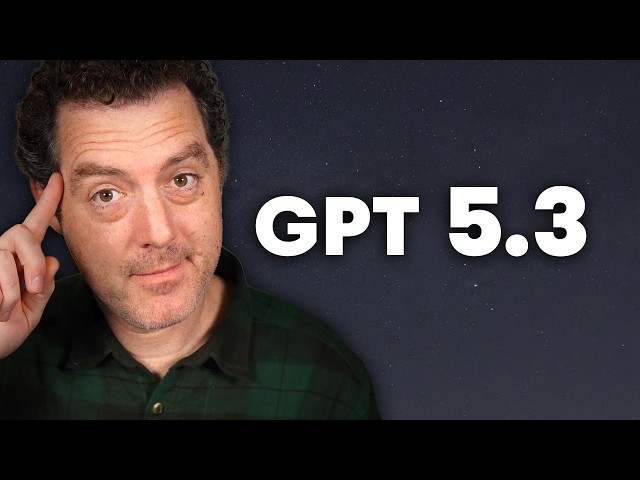
Ever wondered where the future of software development is headed? I recently came across a fantastic breakdown that captures one of the most exciting moments in AI history—OpenAI and Anthropic releasing major model updates within minutes of each other. The video dives deep into GPT 5.3 Codex and how it stacks up against Anthropic’s Opus 4.6, and the implications are massive for anyone who writes code or works with AI.
In this post, we’ll explore the key improvements in GPT 5.3 Codex, what makes this release significant, and why the convergence of these frontier labs on agentic coding signals a fundamental shift in how software gets built.
The Industry Has Picked a Direction: Agentic Coding
Both OpenAI and Anthropic are going all-in on agentic coding. This isn’t a coincidence—it’s a clear signal about where the entire industry is headed. Long-horizon tasks, autonomous agents, sub-agents, and agent teams are no longer experimental concepts; they’re becoming the primary focus of frontier AI development.
What does this mean for you? If you’re a developer, the tools you use are about to change dramatically. We’re moving from AI that assists with individual code snippets to AI that can own entire development workflows, debug its own work, and even improve upon itself.
GPT 5.3 Codex: Self-Improvement Becomes Reality
Here’s where things get genuinely mind-bending: GPT 5.3 Codex was instrumental in creating itself. Let that sink in for a moment. The Codex team used early versions of the model to debug its own training, manage its own deployment, and diagnose test results and evaluations.
This is approaching autonomous self-improvement. While humans are still prompting and directing the process, we’re watching a previous version of a model actively create the next version. It’s recursive improvement in action, and it represents a significant milestone in AI development.
OpenAI’s bold claim is that GPT 5.3 Codex “goes from an agent that can write and review code to an agent that can do nearly anything developers and professionals can do on a computer.” That’s an enormous statement, but the benchmarks suggest they might be onto something.
Speed Through Efficiency, Not Just Raw Power
One of the biggest complaints about previous Codex models was speed. Many developers acknowledged it as the best coding model available but found it painfully slow compared to alternatives like Opus. The 5.3 update addresses this with a claimed 25% speed increase—but the interesting part is how they achieved it.
The speed gains don’t come from faster inference. Instead, OpenAI engineered the model to achieve the same results with dramatically fewer tokens. On SweetBench Pro, GPT 5.3 Codex used only 43,000 total output tokens compared to 91,000 for GPT 5.2 Codex. That’s less than half the tokens for comparable or better results.
This efficiency-first approach is clever because it reduces costs, improves response times, and demonstrates a more sophisticated understanding of how to solve problems without unnecessary verbosity. The model is learning to be concise while remaining effective.
Mid-Task Steering: A Game-Changer for Workflows
One of the standout features of GPT 5.3 Codex is the ability to steer it mid-task. This is fundamentally different from how most AI coding assistants work today, where you typically set a task and wait for completion before providing feedback.
With mid-task steering, you can intervene while the agent is working, redirecting its approach or correcting course without starting over. For complex, long-running development tasks, this capability transforms the human-AI collaboration dynamic from sequential to truly interactive.
Autonomous Game Development: A Proof of Concept
To demonstrate the model’s capabilities, OpenAI had GPT 5.3 Codex build two complete games autonomously: a racing game and a diving game. The process was remarkably hands-off—the model ran essentially by itself, generating the games over millions of tokens with minimal human intervention beyond occasional prompts like “fix the bug” or “improve the game.”
The racing game featured multiple racers with decent physics, while the diving game included a submersible, various fish, multiple levels, objectives like avoiding predators, and even an oxygen limit mechanic. Are these AAA titles? Obviously not. But they were created autonomously in a short period with minimal prompting.
The real significance isn’t the games themselves—it’s the implication. These models will only get better. The day when complete games are prompted from scratch with near-zero human coding is approaching faster than many anticipated.
Understanding Intent with Underspecified Prompts
For those of us who engage in “vibe coding”—describing what we want without knowing every technical detail—GPT 5.3 Codex offers meaningful improvements. The model is now better at understanding intent even when prompts are underspecified.
This means you can describe what you’re trying to build in general terms, and the model will make sensible decisions about implementation details and defaults. It bridges the gap between “I know what I want” and “I know exactly how to specify it technically.”
A practical example: when asked to build a landing page with a vague description of “soft SaaS aesthetic, glassy cards, lavender to blue gradient,” GPT 5.3 Codex produced a significantly more polished result than its predecessor. It automatically displayed yearly plans as discounted monthly prices and included month-over-month changes in the dashboard—details that weren’t explicitly requested but made logical sense.
Beyond Coding: The Knowledge Work Expansion
What’s particularly interesting about this release cycle is how both OpenAI and Anthropic are expanding beyond pure coding into broader knowledge work. Claude’s Co-work feature handles PDFs, Excel files, PowerPoint presentations, and general file manipulation. GPT 5.3 Codex is now making a strong push into the same territory.
The examples are compelling: financial presentations for wealth management firms, retail training documentation, analysis spreadsheets, fashion presentations. These aren’t coding tasks—they’re professional knowledge work that has traditionally required significant human time and expertise.
The convergence is clear. Both companies see the future of AI assistants as general-purpose knowledge workers, not just specialized coding tools.
Computer Use Gets a Major Upgrade
GPT 5.3 Codex nearly doubled its predecessor’s score on the OS World benchmark, jumping to 64.7. This benchmark measures a model’s ability to control a computer—understanding where elements are located, identifying buttons and windows, navigating tabs, and successfully executing tasks within an actual operating system.
Computer use capabilities are crucial for agentic workflows. An AI that can only generate code is limited; an AI that can also interact with development environments, browsers, terminals, and other applications can handle end-to-end workflows that more closely mirror how human developers actually work.
The Competitive Landscape Heats Up
It’s worth noting what OpenAI didn’t include in their benchmarks: competitor comparisons. Unlike Anthropic, which included Gemini and OpenAI models in their Opus 4.6 benchmarks, OpenAI’s release focused solely on comparisons between their own model versions.
This is a curious choice. Transparency in benchmarking helps the community understand where different models excel and where they fall short. Anthropic’s willingness to include competitors gives developers better information for choosing the right tool for their specific needs.
That said, the competition between these labs is producing remarkable results for everyone. Each major release pushes the other to improve, and developers are the ultimate beneficiaries.
Conclusion: The Agentic Future Is Here
The simultaneous release of GPT 5.3 Codex and Opus 4.6 isn’t just a product announcement—it’s a declaration of where AI is headed. Both frontier labs have made their bets clear: the future belongs to agentic systems that can handle long-horizon tasks with minimal human intervention.
For developers, this means adapting to a new paradigm. The most successful developers won’t be those who can write the most code—they’ll be those who can most effectively direct and collaborate with AI agents that write code for them.
The tools are here. The question now is how quickly we learn to use them.
What’s your take—are you more excited about Opus 4.6 or GPT 5.3 Codex? Drop your thoughts in the comments, and let’s keep the conversation going.