
The discourse around artificial intelligence has calcified into two predictable camps: techno-utopians promising liberation from labor and existential doomsayers warning of humanity’s obsolescence. Both share an underlying assumption—that we are building something that will eventually think.
George Gilder disagrees. Profoundly.
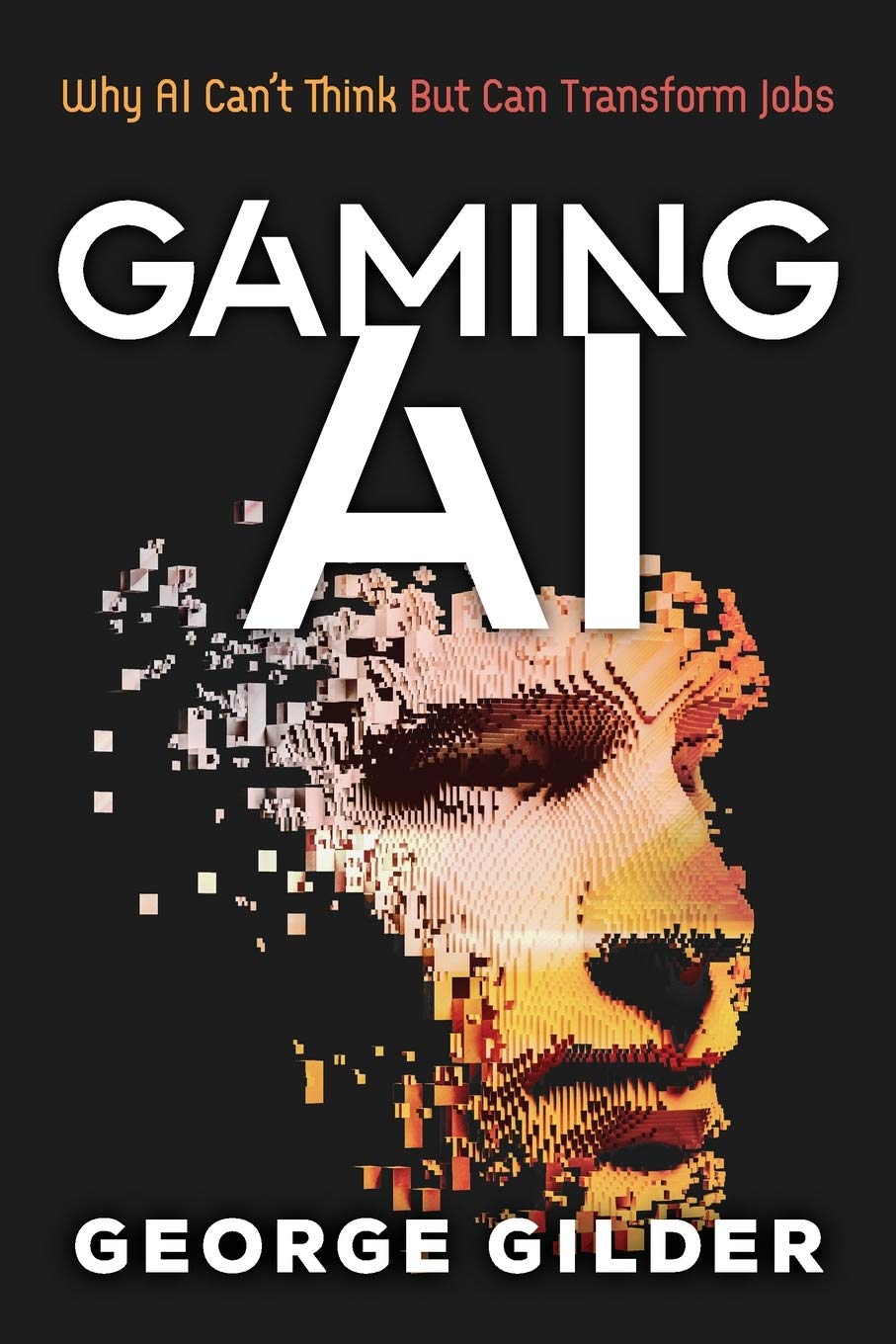
In his provocative work Gaming AI: Why AI Can’t Think But Can Transform Jobs, the economist and technology theorist presents a framework that neither celebrates nor fears the coming of machine superintelligence—because he argues it cannot come at all. The book is less a prediction and more a philosophical intervention, one that forces readers to reexamine what we mean when we say a machine “thinks.”
For those of us who work at the intersection of technology strategy and organizational reality, Gilder’s arguments deserve serious engagement. Not because they’re comfortable, but because they’re grounded in the foundational mathematics of computation itself.
The Prosthetic Thesis
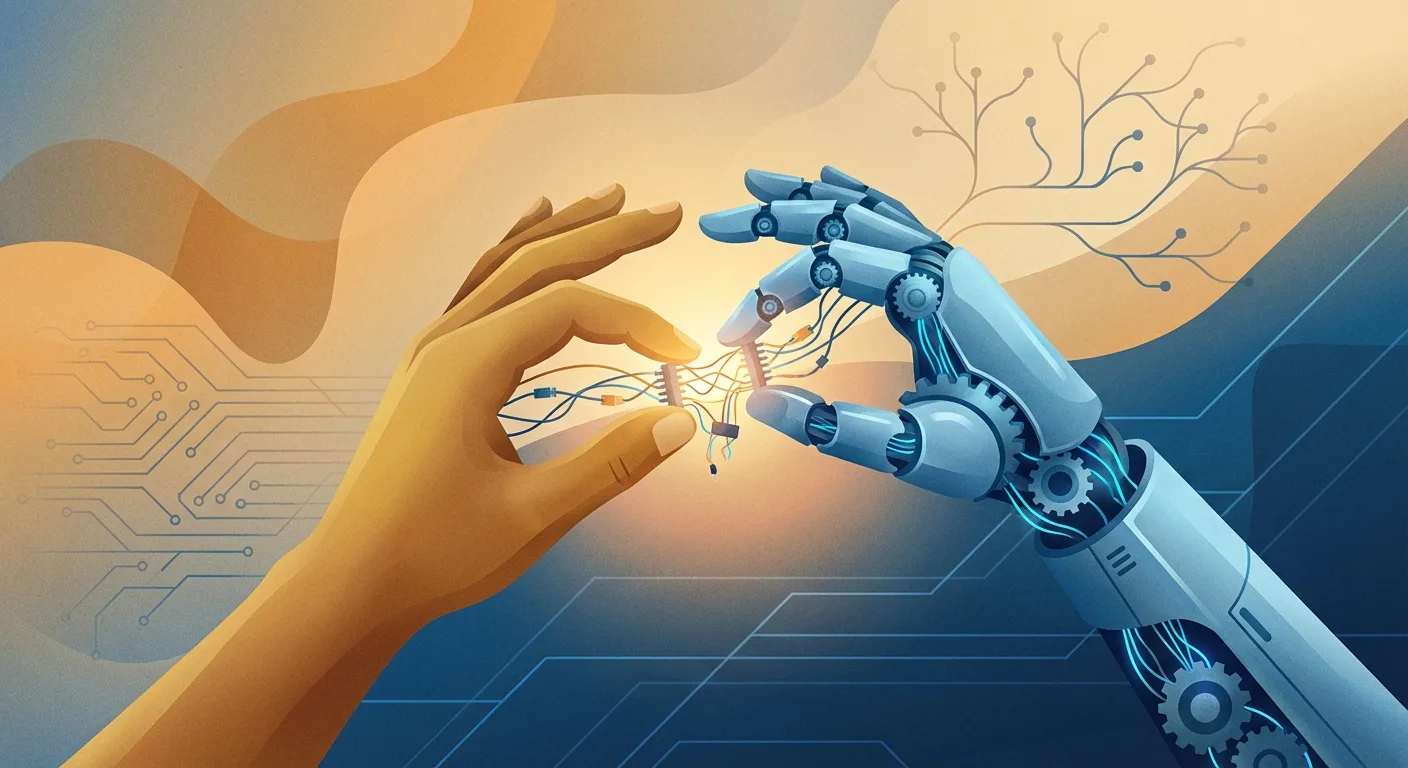
Gilder’s central metaphor is surgical: AI is a prosthetic, not a replacement. A prosthetic hand doesn’t possess the will to grasp—it extends the will of its wearer. Similarly, artificial intelligence extends human cognitive capacity without possessing cognition of its own.
This isn’t mere semantics. The distinction reframes our entire relationship with these systems.
Consider Ren Zhengfei’s vision for Huawei: AI enabling a single person to accomplish the work of ten. Not ten people unemployed, but one person radically empowered. The same pattern emerges across industries—tractors that operate through storms, manufacturing lines holding 10-micron tolerances, analysis engines processing data volumes no human team could manage.
“An industry dependent on human minds—the creators and customers—cannot prosper by making those minds obsolete,” Gilder writes. This is economic logic, not sentiment. The tools serve the toolmakers.
The fear of technological unemployment has accompanied every major innovation from the printing press to the spreadsheet. Each time, the prophecy failed not because the technology was weak, but because human creativity found new frontiers for the newly-augmented labor force. Gilder sees AI as the latest chapter in this recurring narrative, not its final page.
The Singularity as Superstition
Where Gilder truly diverges from mainstream AI discourse is his treatment of the Singularity—that hypothetical moment when machine intelligence surpasses human intelligence and renders us either pets or extinct. He doesn’t merely doubt the timeline. He rejects the premise.
His argument draws on figures that Silicon Valley has largely forgotten: Kurt Gödel and Alan Turing.
Gödel’s incompleteness theorems demonstrated that any sufficiently complex logical system cannot be both complete and self-proving. There will always be true statements the system cannot derive from within itself. Turing, the father of computer science, formalized this limitation in his concept of the “oracle”—an entity outside the computational system that provides axioms the system cannot generate.
Critically, Turing specified that this oracle “cannot be a machine.”
The computer scientists building today’s AI systems have, in Gilder’s view, contracted “a crippling case of professional amnesia.” They’ve forgotten the mathematical constraints their own discipline discovered. No amount of additional processing power resolves Gödelian incompleteness. No dataset, however massive, bridges the gap between symbol and meaning.
This brings us to Gilder’s most philosophically dense critique: the map is not the territory.
When Maps and Territories Diverge
AI systems like AlphaGo achieve superhuman performance in games precisely because, within a game, the map is the territory. The stones on the Go board are simultaneously the symbols and the objects they represent. The rules are fixed. The same inputs always yield the same outputs. This is what Gilder calls an “ergodic” system—deterministic, closed, predictable.
The real world is none of these things.
Economic reality pulses with “black swans” and “butterfly effects.” Entrepreneurial creativity generates genuine novelty—outcomes that could not have been predicted from prior states. The rules themselves change. Markets shift. Cultures evolve. Human beings surprise each other and themselves.
In these conditions, the AI’s map inevitably diverges from the territory it claims to represent. The system optimizes for patterns in historical data while the world generates unprecedented configurations. The model’s confidence becomes a liability precisely when confidence is most dangerous.
This isn’t a temporary limitation awaiting more training data. It’s structural. Gilder argues that “Big Data” suffers from a fundamental delusion—the belief that sufficient quantity can substitute for understanding. But data is not knowledge. Patterns are not comprehension. Correlation is famously, fatally, not causation.
The Indispensable Oracle
If machines cannot generate their own axioms, cannot bridge symbol and meaning, cannot navigate genuinely novel territory—then what can?
Gilder’s answer is the human mind, positioned as the irreplaceable “oracle” in every computational system.
Drawing on the semiotics of Charles Sanders Peirce, he argues that meaning requires three elements: a sign (the symbol), an object (what it represents), and an interpretant (the mind that connects them). Without the interpretant, data is merely binary—patterns without significance, stones without strategy.
When AlphaGo places a piece, it isn’t experiencing victory or contemplating loss. It’s executing mathematical operations that a human programmer designed to correlate with winning states that human game designers defined. The “mind” of the machine is actually the mind of its creators, encoded and executed.
Creativity, Gilder insists, is “non-algorithmic and therefore uncomputable.” Machines can simulate creative processes after humans have encoded them. They can recombine existing elements in ways that appear novel. But the genuine spark—the axiom from outside the system—must come from the oracle.
This has profound implications for how we think about AI development. We’re not racing toward a moment when the tool becomes the toolmaker. We’re building increasingly sophisticated extensions of human creative capacity. The question isn’t whether AI will replace human judgment, but how we can best structure human-AI collaboration.
The Materialist Superstition
Gilder reserves his sharpest critique for what he calls the “materialist superstition”—the assumption that consciousness is merely computation, that the brain is “wetware” awaiting silicon emulation.
His challenge begins with physics. The human brain operates on roughly 14 watts. The global internet infrastructure achieving often-simpler tasks requires gigawatts—billions of times more energy. If the brain were merely a digital computer, why this staggering efficiency gap? Gilder suggests the brain may operate on quantum principles fundamentally different from classical computation.
More devastating is what he calls “Stretton’s paradox.” Scientists mapped the complete connectome of the nematode worm C. elegans decades ago—all 302 neurons and their connections. Yet we still cannot predict its behavior from this wiring diagram. Knowing the material connections does not reveal the “source code” of meaning.
If complete structural knowledge of 302 neurons doesn’t yield understanding, what hope is there for reverse-engineering 86 billion?
The ambition to build consciousness from silicon, Gilder argues, “defies the deepest findings of quantum theory.” It treats the mental as an emergent property of the material, when the observer—the interpretant, the oracle—may be something the material sciences cannot fully capture.
This is not an argument against AI research or deployment. It’s an argument against a particular metaphysical assumption that has infected that research—the belief that we are building minds rather than tools.
Implications for Practice
If Gilder is correct—or even partially correct—the implications ripple across technology strategy, governance, and organizational design.
First, integration over replacement. Organizations should architect AI systems as cognitive prosthetics that extend human capability rather than autonomous agents that replace human judgment. The goal is augmentation, not automation of the irreplaceable.
Second, preserve the oracle function. Critical decisions require human interpreters who can recognize when the map diverges from the territory. Delegating judgment to algorithmic systems is not efficiency—it’s abandonment of the one capacity machines cannot replicate.
Third, humility about generalization. AI systems trained on historical data will optimize for patterns that may not persist. Entrepreneurial insight, strategic creativity, and adaptive judgment remain human domains precisely because they involve navigation beyond the training distribution.
Fourth, reconsider the talent equation. If AI is prosthetic, then the humans wielding these tools become radically more valuable, not less. Investment in human expertise and judgment becomes more important as the tools become more powerful.
A Thought Experiment
Consider this: if the Singularity enthusiasts were correct, we would expect AI systems to demonstrate increasing autonomy in defining their own objectives. Instead, we observe the opposite—systems exquisitely sensitive to their training data, reward functions, and prompt engineering. The “intelligence” remains downstream of human specification.
The systems are not straining toward independent agency. They are powerful, intricate, occasionally surprising executors of human-defined tasks. This is precisely what Gilder’s framework predicts.
Perhaps the most significant contribution of Gaming AI is not its conclusions but its questions. It forces us to ask what we actually mean by “intelligence,” whether computation and cognition are synonymous, and whether the mathematics of our own discipline contains constraints we’ve conveniently forgotten.
The Singularity may never arrive—not because we lack the engineering capability, but because the destination doesn’t exist. We may be building the most powerful prosthetics in human history while hallucinating that we’re building minds.
If so, that’s not a tragedy. It’s a correction. And perhaps a liberation.
George Gilder’s “Gaming AI: Why AI Can’t Think But Can Transform Jobs” is available from major booksellers. For those interested in the philosophical foundations of his argument, his earlier work “Knowledge and Power” provides additional context on information theory and economics.